
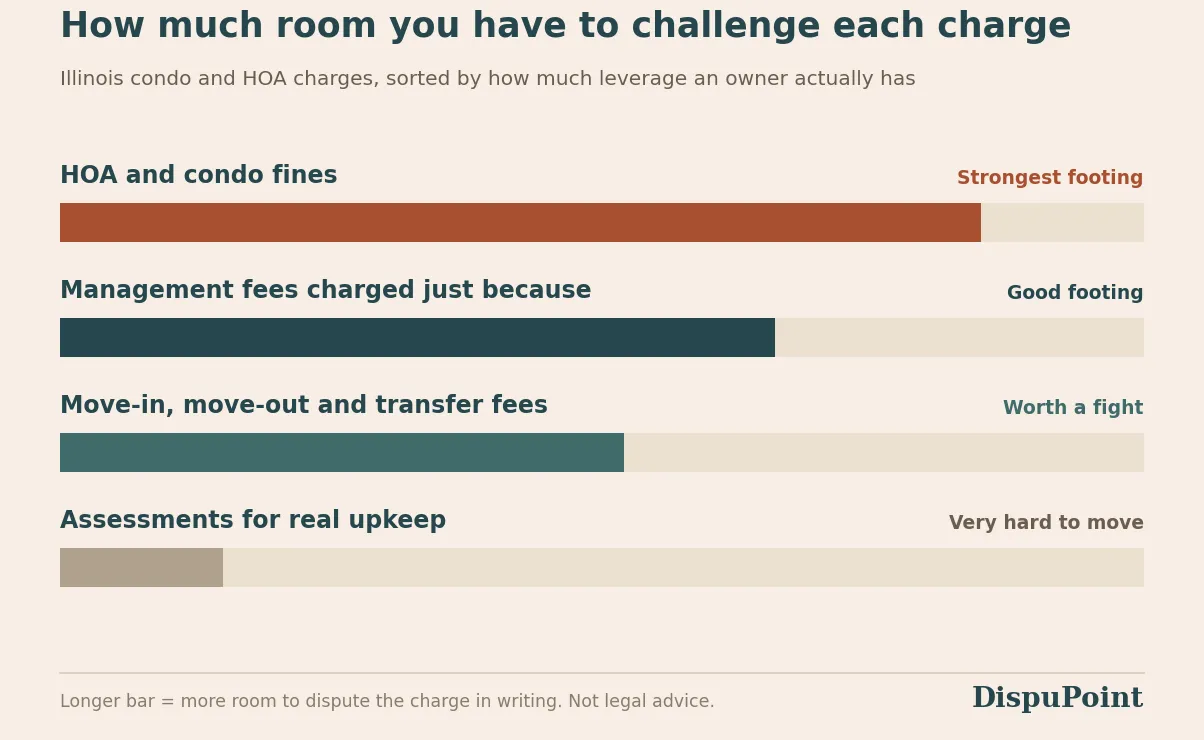
It depends which charge you're staring at. A board can't erase a real assessment just because you asked nicely. But a fine, or a management fee tacked on just because, is a different story. Knowing which pile each charge falls into is what decides how hard you can push.
Sort your charges into piles first
Not every line on that statement is the same kind of animal. Some are penalties for breaking a rule. Some pay for the grass getting cut and the roof staying on. And some are fees a management company charges because a form crossed a desk. They live under different rules, so lumping them together is how owners lose the argument before it even starts.
Pile one: fines
Fines are penalties for breaking a rule, and in Illinois a board can't just drop one on you. Both the condo law and the HOA law say the same thing: you get written notice and a real chance to be heard before any fine sticks. Skip that step, and the fine has a hole in it.
There's more. A fine has to point to an actual rule you actually broke. Illinois courts have been blunt here: a condo association is a creature of statute, and anything it does to you has to trace back to its own documents or the law. If the notice can't name the rule, ask in writing which one it is. A lot of boards go quiet right there.
Pile two: assessments for the actual upkeep
This is the backbone, and it's the hardest to move. Your regular assessment funds shared expenses: landscaping, the reserve fund, insurance, the elevator. Illinois law treats those as close to untouchable, and a board that forgives them for one owner while billing everyone else is asking for a fiduciary-breach headache. That cuts both ways, which is exactly why they can't waive yours on a whim either.
What you can question is the process. Was the budget properly adopted? Did a special assessment skip a required vote or notice? Those are real openings. But a validly levied assessment for genuine upkeep is not getting waived, and anyone promising otherwise is selling you something. If your real question is whether you can stop paying altogether, we walk through that here.
Pile three: the fees a management company charges just because you exist
Now the interesting pile. Transfer fees, account-setup fees, status-letter fees, processing fees. The charges that show up not because real work happened, but because your unit changed hands or your name changed on a form. This is where the money quietly hides.
Two levers here. First, the resale disclosure packet: Illinois caps what an association or its manager can charge to produce it, adjusted for inflation each year, with a small add-on allowed for rush jobs. Bill you triple that for a stack of PDFs and they're over the line. Second, and bigger: every other fee has to be authorized somewhere and disclosed to you. If a charge isn't in the declaration, the bylaws, a properly adopted rule, or the management contract your association actually signed, it's floating in mid-air. Make them show you where it comes from.
The bonus round: move-in, move-out, and transfer fees
These earn their own pile because they hit at the worst possible time, when you're already paying movers, a lender, and a title company. There's no special Illinois cap on a move-in or transfer fee the way there is on the disclosure packet. But the same test applies: is it authorized, and was it disclosed? A fee nobody agreed to, on a schedule nobody published, does not get stronger just because it's inconvenient to fight.
I've been on this exact end of it. When I refinanced my own place and moved it from family ownership into an LLC, then brought tenants in, the management company sent over a stack of fees. Some were fair, real work went into them. Others were charged just because paperwork moved. So I pushed back. I asked for the fee schedule, and it wasn't on the owner portal at all. When I lined the charges up against our bylaws, a chunk of them had nothing behind them. That's the whole game: make them show you the authority for each charge, one at a time.
How to push back in writing
Verbal complaints evaporate. A written dispute creates a record and puts the board or its manager on the clock. Send it certified, keep a copy, and ask for one specific thing: the authority behind each charge. Here's a letter that does exactly that.
How to
Dispute an HOA fine or a management fee in writing
Send this to the board or its management company by certified mail so you have proof it arrived. Keep a copy for your file. This starts the paper trail and forces a written answer.
[Your Name]
[Your Address]
[City, IL ZIP]
[Date]

[Association Name] Board of Directors
c/o [Management Company Name, if applicable]
[Address]

Re: Written Dispute of Charges - Unit/Lot [Your Unit or Lot Number]

Dear Board Members,

I am writing to dispute the following charge or charges on my account: [list each charge, the amount, and the date it was applied].

For each charge listed above, I am requesting the following in writing:

1. The specific provision of the declaration, bylaws, rules, or management agreement that authorizes the charge.
2. A copy of the association's current fee schedule, including where it is published for owners to see.
3. For any fine, written confirmation of the notice I received and the opportunity to be heard that was provided before the fine was imposed.

If any charge cannot be tied to an authorized provision, I ask that it be removed from my account.

Please respond in writing within 10 business days of receiving this letter. I am sending it by certified mail and am keeping a copy for my records.

Sincerely,
[Your Name]
[Phone / Email]
This letter does one thing well. It moves the burden onto the board to show its authority for each charge, and a charge that can't be tied to the governing documents or a published schedule is the easiest kind to get dropped.
That letter is step one.
You can send the above letter, or we can handle the whole case ourselves, from start to finish.
Get my free assessmentNo payment now. The $349 only starts your case if you act.
FAQ
Can an HOA board waive fees for some owners and not others?
Not safely. Selectively waiving assessments creates unequal-treatment and fiduciary problems under both the Illinois Condominium Property Act and the Common Interest Community Association Act. A board can apply a written hardship policy, but only if it applies that policy evenly to everyone who qualifies.
Can HOA late fees be waived in Illinois?
Sometimes. Late fees charged in error, meaning the wrong amount, the wrong date, or applied after you'd already paid, are worth disputing in writing. A late fee riding on top of a fine that had a procedural problem can fall right along with it. A valid late fee waived as a courtesy is the board's call.
Is there a limit on what a management company can charge for condo documents?
Yes. Illinois caps the fee for producing the resale disclosure packet, adjusted for inflation each year, with a small extra allowed for rush service. Other fees aren't capped the same way, so those you challenge on a different question: whether they were authorized in your governing documents and actually disclosed to you.
What if the board ignores my written dispute?
Silence is still a record, and it tends to work in your favor. Keep every copy, note the dates, and escalate from there. Owners have more leverage over a board than most realize, and we cover how that accountability actually works here.
Do I have to pay a charge I think is wrong while I dispute it?
That's a judgment call worth thinking through. An unpaid charge can grow late fees, and for a real assessment it can eventually become a lien on your unit. Disputing in writing first protects you better than simply refusing to pay. Get the authority question answered before you decide anything.
How do I dispute an HOA fee in Illinois?
Send this to the board or its management company by certified mail so you have proof it arrived. Keep a copy for your file. This starts the paper trail and forces a written answer.