A fine lands. Taped to your door, buried in a statement, or in an email that calls you "the owner." Your blood's up, and your first move is to argue the fine itself. The trash cans. The fence. The neighbor who does the same thing and never hears a word. Stop. That's the fight they want. It's slow, it's opinion against opinion, and they'll outlast you. Illinois law gives you a faster one. Before any board here can fine you, it has to do a few specific things first. Skip them and the fine's standing on air.
What Does Illinois Law Actually Require Before a Fine?
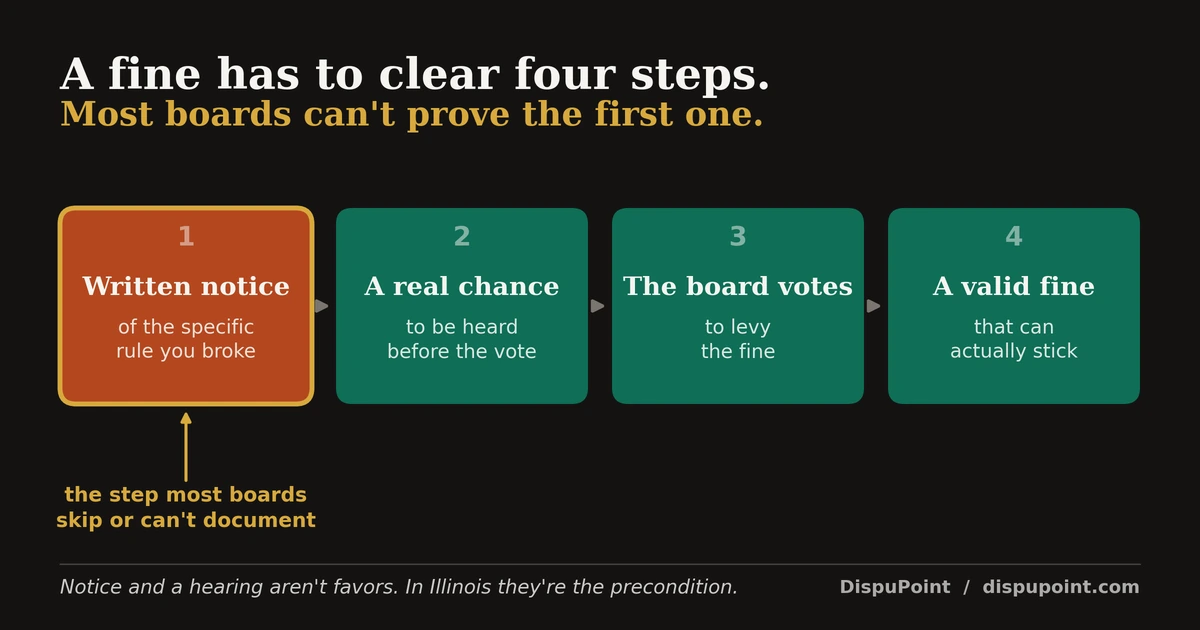
Boards hope you never learn this part. They don't get to just decide you owe money. Both laws that govern community associations in Illinois say the same thing: written notice of the violation, and a real chance to respond, before any fine.
Condos: 765 ILCS 605/18.4(l). HOAs under the Common Interest Community Association Act: 765 ILCS 160/1-30(g). Two statutes, one floor. Notice and a hearing come first. They're not optional.
Illinois courts have already tossed fines where the board couldn't show it gave proper notice or a real chance to be heard. That's not a loophole. That's the law as written.
Some associations turn out to have no fining power at all. One board's only documented sanction was a suspension it never voted on.
What Counts as Proper Notice?
Notice isn't a feeling. It's a document with your name on it naming the rule you broke. A reminder to the whole building doesn't count. A mention at a meeting doesn't count. "Everybody knows the rule" doesn't count.
So when their whole case is "we notified you several times" and nobody can produce a single document, that's not notice. That's a story. The statute doesn't accept stories.
What Does "Opportunity to Be Heard" Mean?
It doesn't mean robes and a gavel. It means you get to face the board, or a committee, and say your piece before they decide. Before. Not after.
This is your shot, so come loaded. Photos, dates, the neighbor's identical fence nobody's touched. Say all of it out loud at the hearing and get it into the minutes, because the minutes are the record. Every reason they're wrong, or just being hypocrites, lives on paper the second you put it there.
Here's where boards get cute. They vote the fine, drop it on your account, then offer you an "appeal." That's backwards, and backwards doesn't satisfy the statute. Notice first. Your turn second. The fine last. Run the order in reverse and the board's breaking the rule it's enforcing on you.
Why Most Homeowners Fight the Wrong Battle
The instinct is to argue the merits. The trash can was out one extra night. My fence matches the one down the block. You're not wrong. But that's their field, where everything's a judgment call and they hold the whistle.
Procedure isn't a judgment call. The notice exists or it doesn't. You got a hearing before the vote or you didn't. If they can't show both, you're not trading opinions anymore. You're holding a gap they can't fill.
How to Get the Records That Tell You Where You Stand
You don't have to take their word. Illinois gives members the right to inspect the records. Condos: 765 ILCS 605/19. HOAs: 765 ILCS 160/1-30. Ask for the notices they claim they sent, the exact rule they're citing, and the minutes from the meeting where they voted the fine.
For condos, the clock is real. The board generally has 10 business days to hand over records like the minutes and governing documents, and blowing the deadline counts as a denial you can act on. Put it in writing. Don't call. A call evaporates. A written request leaves a trail, starts the clock, and tells them you're not paying up and going away.
How to
Request your HOA fine documentation in writing
Send this to your association's management company or board secretary. Use a method you can track, like certified mail or an email with a delivery receipt, and keep a copy. It puts your request on the record and forces a formal response.
[Your Name]
[Your Address]
[City, State, ZIP]
[Date]

[Association Name]
c/o [Management Company Name, if applicable]
[Association Mailing Address]

Re: Written Records Request - Fine Issued [Date of Fine]

To Whom It May Concern:

I am a member/owner at [Address/Unit Number] in [Association Name]. On or around [date], I received a fine of $[amount] for an alleged violation of [rule description, if known].

Under [765 ILCS 160/1-30 / 765 ILCS 605/19 - use whichever applies to your association], I am requesting copies of the following records:

1. The written notice of violation sent to me prior to this fine, including the date it was sent and the method used to deliver it.
2. The specific rule or provision of the governing documents I am alleged to have violated.
3. Any board meeting minutes or committee records reflecting the vote or decision to levy this fine.
4. Documentation of the hearing or opportunity to be heard that was offered to me before the fine was imposed.

Please provide these records within the time period required by Illinois law. I am available to review them at a mutually convenient time, or you may send copies to the address above.

[Your Name]
[Your Phone or Email]
If the board can't produce written notice and proof that you were offered a hearing, the preconditions under 765 ILCS 605/18.4(l) or 765 ILCS 160/1-30(g) weren't met. That's the factual hole you build a challenge on.
That letter is step one.
You can send the above letter, or we can handle the whole case ourselves, from start to finish.
Get my free assessmentNo payment now. The $349 only starts your case if you act.
What Happens If the Board Can't Produce the Records?
An empty file isn't a shrug. If they swear they followed the process and can't show one document, that silence is the case. You write back, in writing, citing the statute, stating plainly that the notice and hearing the law requires never happened. Now you're not a homeowner with a complaint. You're a member holding the board to the law.
This is the part most people get wrong. They either fold, or they jump straight to a lawyer they can't afford over a fine that doesn't justify one. There's a step in between, and that's what we do. We read your fine against Illinois law, find the procedural gaps the board's hoping you miss, help you build the documented record, and get you ready for small claims if it comes to that. If it does escalate, you hand an attorney a clean dossier instead of a shoebox. You walk in organized, not panicked.
FAQ
Can my HOA fine me without sending me a written notice first?
No. The Condominium Property Act (765 ILCS 605/18.4(l)) and the Common Interest Community Association Act (765 ILCS 160/1-30(g)) both require written notice of the violation and a chance to be heard before a fine's valid. Skip those and the fine's procedurally defective, whatever you supposedly did.
What records should I ask for to challenge an HOA fine in Illinois?
Ask for the written notice they claim they sent, the exact rule they're citing, the board or committee minutes showing when the fine was approved, and any record of the hearing you were offered. If the board followed the law, all of it exists.
What if my HOA says it notified me verbally or at a meeting?
Doesn't count. The statute wants written notice of a specific violation aimed at you, not an announcement or a hallway chat. If they can't hand you a document, the notice requirement almost certainly wasn't met.
Is there a limit on how much my HOA can fine me?
Illinois doesn't set one universal cap. Your association's own fine schedule, usually in the rules or the declaration, sets the amount. But the dollar figure's the second question. Even a correct amount is invalid if the board skipped notice and a hearing.
Can I dispute an HOA fine myself, or do I need a lawyer?
You can start on your own, and a written records request is the right first move. Most fines don't justify a lawyer's retainer, but they're not nothing either. That's the gap we work: we assess the fine, document it, and prepare you for small claims, or build a dossier you can hand off if it escalates.