
You came home and something was off. A truck you didn't recognize had been parked in your yard. A stranger had been poking around your sewer cleanout and your French drain. And your downspouts were gone, pulled off the house and thrown in the trash. Nobody called. Nobody knocked. And when your wife asked the guy what was going on, he shrugged and said he wasn't the one to complain to.
That shrug is where this starts. Because somebody sent him, and who that somebody is decides everything that happens next.
Who sent that contractor, and why it's the whole ballgame
Before you write a single angry email, you have to nail down one fact: who authorized this. It splits into two worlds, and they don't share a rulebook.
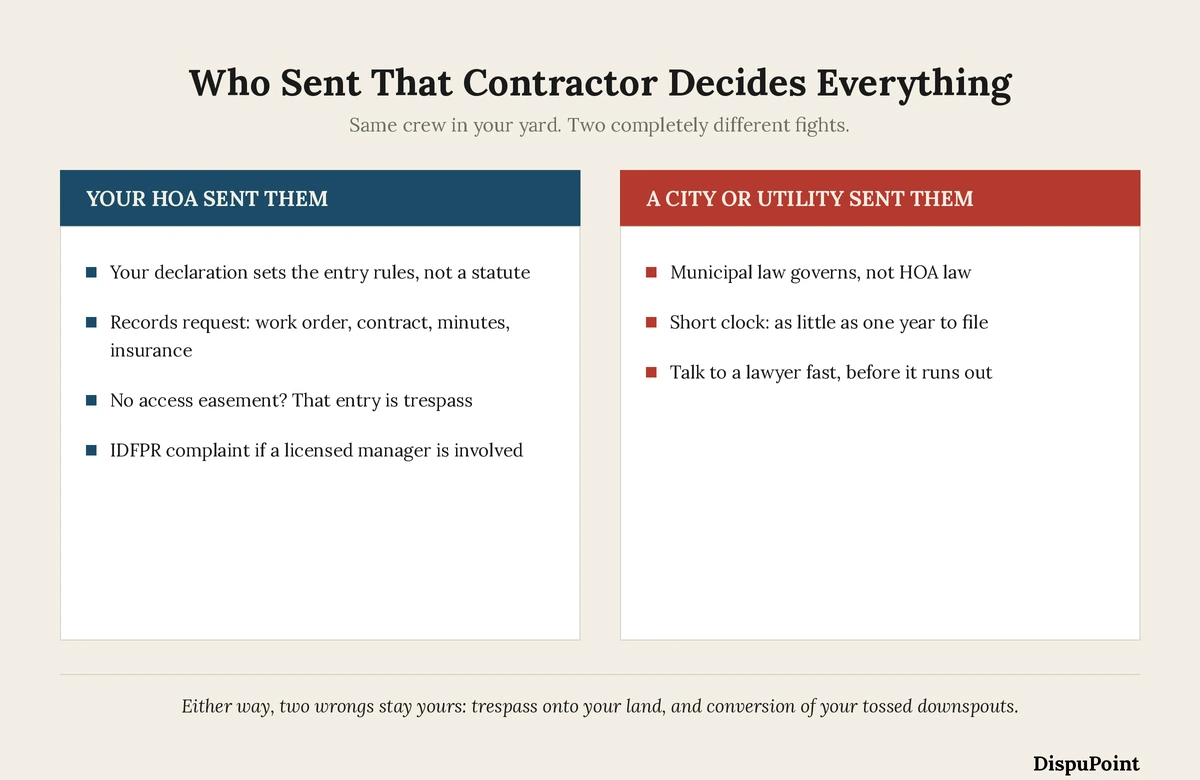
If your HOA hired the crew, you're in association-and-property territory and you've got real leverage. If a city or a utility district sent them, you're in a different world with a much shorter clock, and I'll get to that at the end. Same truck in your yard, two completely different fights. So the first move isn't rage. It's the question: who told this man he could be on my land?
Did your HOA even have the right to be on your land?
Here's where most posts on this lie to you, so I won't. There is no Illinois statute that says an HOA has to give you 48 hours' notice before walking onto your property. That number gets repeated everywhere, and it's real, but it's about something else entirely: it's how much warning a board owes you before a board meeting. It has nothing to do with a boot in your yard.
So where does an HOA's right to enter your lot actually come from? One document. Your declaration, the recorded set of covenants you got at closing. A lot of HOA declarations hand the association an easement to come onto your lot to maintain shared drainage, sewer lines, and the like. If yours does, the crew may have had a right to be there, and the fight narrows to how they did it and what they took. If it doesn't, that entry was trespass, plain and clean.
Whether they owed you any warning at all, and how much, lives in that same document, not in a statute somebody half-remembered. So you pull the declaration and you read the access and easement sections before you accept a word anyone tells you.
Nobody said anything to us. Maybe that's a violation and maybe it isn't. The declaration decides. But it never excuses the next part.
Taking your downspouts is a separate wrong, and a bigger one
Say the board had every right to inspect that sewer line. Fine. Ripping your downspouts off the house and throwing them away is a whole different animal, and no drainage easement covers it.
Under Illinois common law that's conversion: someone took your property and disposed of it without your say-so. Doesn't matter if they thought they were helping. Doesn't matter if a work order told them to. The downspouts were bolted to your house and they were yours. Pair that with trespass, unauthorized boots on your land, and you're not in some fuzzy HOA rulebook squabble anymore. You're holding two ordinary civil wrongs that exist completely apart from any association process, and that a small claims judge understands in about four seconds.
Document it now. Photograph the empty brackets, the tossed downspouts if you can still find them, any damage to the siding or foundation where they were torn off. Get a written estimate to replace them. That estimate is a number, and numbers are what make a claim move.
What Illinois law actually hands you
Now the part that does carry statutory teeth. If your community runs under the Common Interest Community Association Act, you have a records-inspection right, and it's exactly the crowbar you need. You can demand, in writing, the work order, the contract, whatever authorization the board claims it had, the board minutes where this got approved, and the contractor's insurance. Silence past the deadline is its own violation.
One honest caveat. Very small associations can be exempt from that records provision, and if a private utility rather than the HOA sent the crew, this lever doesn't reach them at all. But if there's a licensed property manager in the mix, you've got a second one: the manager is licensed by the state, and you can file a complaint with the Illinois Department of Financial and Professional Regulation yourself. No board vote, no lawyer.
Write first. Argue later.
The instinct is to call the manager and unload. Don't. A phone call evaporates, and the board knows it. A letter creates a record, forces a written answer, and tells them you're not the soft target they took you for. Write.
How to
Demand a written explanation and restitution from your HOA board
Send this to the board president and the property manager by email with a read receipt requested, then follow with a printed copy by certified mail. Keep every reply you get.
[Date]

To: [HOA Board President] and [Property Manager]
Re: Unauthorized Entry and Removal of Property at [Your Address]

On [date of incident], a contractor I understand to be [company name] entered my property at [Your Address] without my consent and without any emergency. During that visit, the contractor inspected my private sewer cleanout and French drain, and removed and discarded my downspouts.

I am requesting the following in writing within 14 days:


Confirmation of whether the board authorized this contractor's access to my property, and a copy of any work order, contract, or written authorization for it.
The specific provision of the association's declaration the board relies on as its right to enter my lot.
The contractor's name and insurance information.
The board's plan to replace my downspouts and repair any resulting damage, at no cost to me.


If I do not receive a written response within 14 days, I will pursue the remedies available to me, including a records request under the Illinois Common Interest Community Association Act, a complaint to the Illinois Department of Financial and Professional Regulation if a licensed manager is involved, and civil claims for trespass and conversion of my property.

Sincerely,
[Your Name]
[Address / Phone / Email]
A dated demand with a deadline builds the record, makes the board answer on paper instead of stalling on the phone, and signals you know exactly which document their authority has to come from.
That letter is step one.
You can send the above letter, or we can handle the whole case ourselves, from start to finish.
Get my free assessmentNo payment now. The $349 only starts your case if you act.
If it was the city, not the HOA
Here's the fork I promised. If that crew was working for a municipality or a utility district instead of your HOA, association law doesn't govern the entry, and the clock changes on you hard. Claims against a unit of local government in Illinois run on a much shorter limitations window than an ordinary lawsuit, as little as one year under the state's Tort Immunity Act. Miss it and the claim is gone, no matter how right you were.
So if your written questions can't confirm the HOA authorized this, treat that as the loud signal it is and talk to a lawyer who handles municipal claims before that year burns. This is the one branch of this whole thing where waiting actively costs you.
FAQ
Can my HOA send a contractor onto my property without telling me first?
It depends on your declaration, not on a statute. There's no Illinois law setting a fixed notice period before an HOA enters your lot. The association's right to come onto your property, and any notice it owes you, come from the recorded declaration. Pull it and read the access and easement sections first.
Isn't there a 48-hour notice rule in Illinois?
Yes, but not for this. The 48-hour figure in Illinois association law is how much notice a board owes members before a board meeting. It has nothing to do with entering your property. Anyone citing it for a contractor visit is pointing at the wrong door.
Can I sue if an HOA contractor removed my downspouts?
Illinois recognizes conversion, the wrongful taking or disposal of your property, as a civil claim separate from any HOA dispute. If a crew tore off and discarded your downspouts, you have a potential claim for their replacement value whether or not the association followed its own rules.
What records can I demand from my HOA after this?
If your association falls under the Common Interest Community Association Act, you can request the work order or contract authorizing the visit, any notice the board claims it sent, the approving board minutes, and the contractor's insurance. Put it in writing and keep proof of delivery.
What if the contractor was hired by the city, not the HOA?
Then your claim shifts to municipal law, which carries a much shorter deadline, as little as one year under the Illinois Tort Immunity Act. If you can't confirm HOA authorization, get legal advice quickly, because that clock does not pause.
FAQ
How do I formally complain to my HOA about an unauthorized contractor visit?
Send this to the board president and the property manager by email with a read receipt requested, then follow with a printed copy by certified mail. Keep every reply you get.