
Picture a small to midsized Illinois condo association staring down a $250,000 roof job. The management contract they're being pitched has a 5 percent "capital project" fee baked in.
Let's do the math.
That's $12,500 to the management company on top of everything else, for "overseeing" a roof. And here's the part that should make your jaw tighten: the board did all the real work. The board got the bids, checked the references, picked the roofer, signed the check.
That $12,500 is so the property management company could "get a little taste."
And this isn't a horror story I made up.
It's the kind of question Illinois homeowners ask out loud all the time. Is this normal? Is this high? They already know something feels off about their current company too. As one of them put it about the manager they're trying to replace: they don't do anything anyway.
Here's something nobody tells you when you buy your condo: your property management company can get paid for work it doesn't do. This isn't some shady backroom where people whisper over stacks of unmarked bills. It's right there in a contract you probably glanced at while hunting for where to drop your initials. Some little line that might read:
Manager shall be entitled to a fee equal to five percent (5%) of the total cost of any capital project, repair, or improvement undertaken by the Association.
Right there. That little line legally entitles your management company to a cut of any work done to your property for doing literally nothing. Nada. Rien. Nichts. Zilch. Shall I go on?
I'm not going to tell you it's illegal. Mostly it isn't. I'm going to tell you it's worth getting annoyed about, and then worth doing something about. Those are two different things. This is about both.
The three fees, and the one you'll never see
Most owners think they pay their management company through one fee. They pay through three. Only the first one is out in the open.
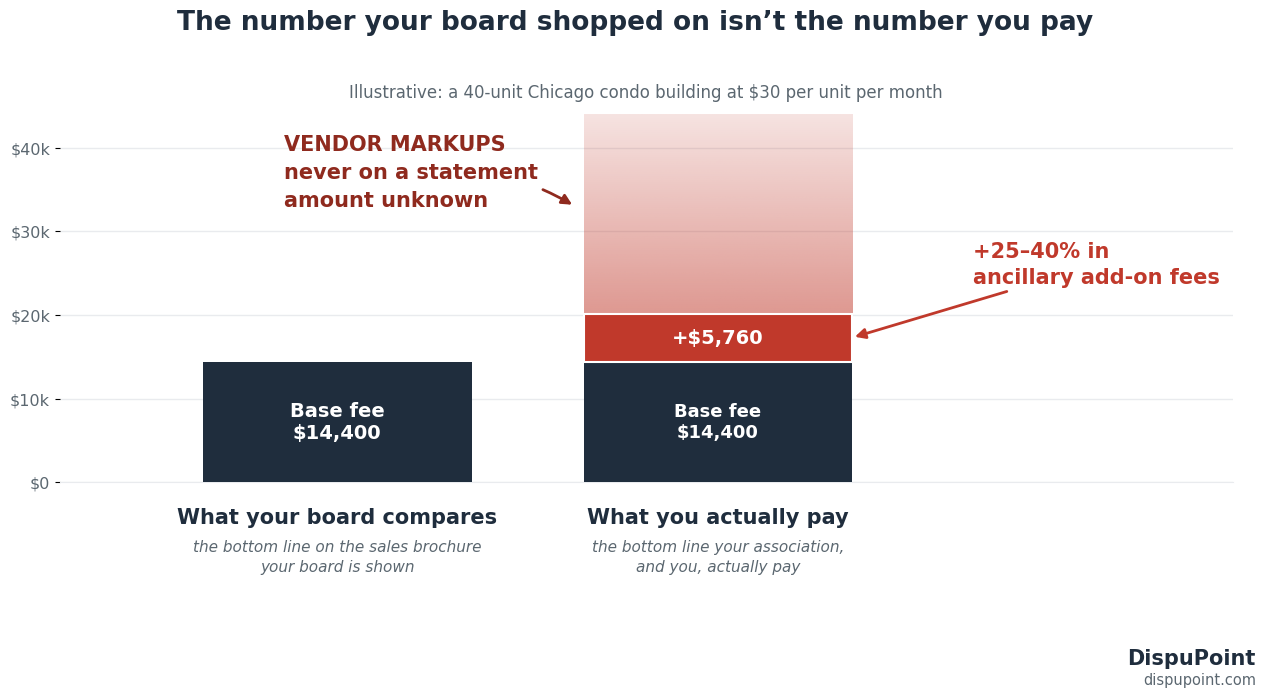
The first one, the base fee, is the number boards actually look at. For a portfolio-managed Chicago condo building it tends to land between $20 and $45 per unit per month, going by the rates Chicago firms publish themselves. Forty units at $30 a unit is $14,400 a year. That fee buys the real work: collecting assessments, paying bills, prepping meetings, keeping the books, lining up vendors. No complaint there. That's a job.
Then comes the second set, the add-ons, and this is where the fog rolls in. Document fees when a unit sells. Transfer fees. Move-in and move-out fees. A charge for every board meeting past the few the base fee covers. A few bucks to mail a violation letter. By several industry estimates, the add-ons pile another 25 to 40 percent on top of the base fee. So the headline rate your board lined up against three competitors? Never the real number.
The third layer is the one that never shows up on a statement: the money your management company makes off the vendors. A markup on the contractor's invoice. A slice of a capital project, like that $12,500. A markup on the on-site staff's payroll. Sometimes a payment from the bank holding your reserves. Some firms do all of it. Some do none. And your association often has no idea any of it is happening.
That opacity is the real problem. Owners describe calling the office about a charge and getting nobody who can explain what it's for, only that they owe it. You should never be paying a fee that the company itself can't break down for you.
"We've always done it this way" is not a defense
Somewhere in this conversation, someone says the magic words. "It's standard." "We've always done it this way." And the table nods, because who are you to argue with how it's always been done.
Argue with how it's always been done.
"Standard" describes what companies have gotten away with. That's all it is. It is not a measure of what's fair, and it has never once been a law of nature. Standards are habits that got comfortable. They move the second enough of the people footing the bill stop nodding along.
Look hard at what you're buying when a company skims a percentage off a project your board ran. You're not buying management. Your board managed it. You're buying the company's contractual right to a cut. That's a charge for proximity. You are paying rent on someone being in the room.
The honest version isn't complicated. Charge a real fee for real management. If a company is going to run a capital project, ride the contractor, handle the change orders, chase the punch list, then yes, that's work, pay them for the work. Charge $100 a unit if that's what honest management costs. But don't charge $30 a unit and then quietly clip every project, every letter, every transfer on the way through, and wave it off as the way it's always been done.
And the industry knows the money moves. The Community Associations Institute, the management industry's own professional body, publishes a code of ethics that tells managers to give clients "prompt written disclosure" of any payment they collect from vendors. Read that twice. Their own rulebook assumes the cash is changing hands. The fight was never about whether it happens. It's about whether you're allowed to see it.
So here is what you actually do
Getting annoyed is free. Doing something costs one email and an afternoon. Start here.
1. Get your hands on the contract
Illinois law gives you the right to inspect your association's records, and the management agreement is one of them. For condos that right lives in the Illinois Condominium Property Act (765 ILCS 605). For non-condo HOAs it's the Common Interest Community Association Act (765 ILCS 160). Almost nobody asks for the management contract. They assume it isn't theirs to read. It is. You're the one paying for it. Your right to see that contract sits inside the Illinois HOA laws, not the manager's discretion.
2. Know what a fair contract looks like
Once it's in front of you, here's what separates a contract that respects owners from one that bleeds them. Look for:
- Project fees charged only for actual project management, not an automatic cut of every dollar your association spends. A 5 percent fee on a $250,000 roof is $12,500. Ask exactly what work that buys.
- A complete written rate card for every add-on, so charges can't quietly appear later, and so nobody at the office is left unable to explain a line on your bill.
- No automatic renewal with a sneaky-short cancellation window that locks you in for another year before anyone notices.
- Written disclosure of every vendor markup, commission, or referral payment the company collects. Their own ethics code already calls for this, so there's no reason to refuse it.
- A clean exit. The standard is 30 to 90 days' written notice to end the agreement.
If your association's contract is missing these, nobody needs to panic. You raise it at renewal, with the contract in hand and the terms named.
3. Remember the exit is right there
This is the part most boards forget they have. A management contract is not a marriage. The normal arrangement lets either side walk on 30 to 90 days' written notice, and on the way out the company has to hand over the association's records. If you and enough neighbors think the deal stinks, and the board agrees, hiring a new company is routine. Boards sit in lopsided contracts for years because nobody ever told them how ordinary it is to leave.
You don't need to name a single company to do any of this. You need to know the terms to demand. A contract can always be rewritten before it's signed, and contracts get renewed every single year. Standard or not, that bar moves when you push on it.
The point
A good management company earns every dollar, and this was never about whether they should get paid. It's about the money you can't see and the standard nobody told you was up for negotiation. Even one of the country's biggest management firms says plainly that boards "do not profit from the fees." Fine. So where does it all go, and who signed off on it? You're allowed to ask. You're paying for the answer.
Read the contract. Learn the terms. And the next time someone tells you it's just how it's always been done, remember that "how it's always been done" is a habit, not a rule.
How to
Ask your board, in writing, to see the management contract and fee schedule
Send this to your board's official address or the management company's office, and keep a copy. If you send it by email and get silence, follow up with certified mail.
[Your Name]
[Your Unit Address]
[City, IL ZIP]
[Date]

Board of Directors
[Association Name]
[Association Address]

Re: Request to Inspect Association Records

Dear Board Members,

As a unit owner, and under my right to inspect association records [765 ILCS 605 for condos / 765 ILCS 160 for HOAs, use whichever applies], I'm requesting to review the following:

1. The current management agreement, including every exhibit, fee schedule, and amendment.
2. The complete schedule of any additional or "ancillary" fees the management company can charge.
3. Management company invoices to the association for the past 12 months.
4. Any vendor agreements in which the management company receives a markup, commission, or referral payment.

Please confirm you received this and let me know when and how I can review these records. I'm happy to cover reasonable copying costs allowed by law.

Sincerely,
[Your Name]
[Your Phone or Email]
A written request puts your board on the record and starts the clock under Illinois law. If they stall or refuse, that silence becomes useful on its own.
That letter is step one.
You can send the above letter, or we can handle the whole case ourselves, from start to finish.
Get my free assessmentNo payment now. The $349 only starts your case if you act.
FAQ
Can I see my condo or HOA's management contract in Illinois?
Yes. Under the Illinois Condominium Property Act (765 ILCS 605) for condos, and the Common Interest Community Association Act (765 ILCS 160) for HOAs, owners can inspect association records, and the management agreement is one of them. Put the request in writing to your board and keep a copy of everything you send.
Is a 5 percent capital project management fee normal in Illinois?
It's a fee some companies charge and others don't, so "normal" is the wrong question. The right question is what the fee buys. On a $250,000 roof, 5 percent is $12,500. If the company is genuinely running the project, that may be defensible. If your board is doing the actual work, ask why the fee exists at all. Compare contracts, and treat a project percentage as negotiable.
Is it legal for a management company to mark up a contractor's bill?
Usually, as long as the arrangement is disclosed in the agreement your board signed. Markups on vendor work happen across the trades. The legal line is disclosure, not the markup itself. Whether it's fair is a separate fight, and one you're entitled to pick with your board.
How much should a management company charge in Chicago?
There's no single right number. Base fees for portfolio-managed Chicago condo buildings commonly run $20 to $45 per unit per month, and add-on fees often stack another 25 to 40 percent on top. Ask for a full written rate card so you compare total annual cost, not the headline per-unit rate from the pitch.
How do I get my board to switch management companies?
Most management contracts can be ended on 30 to 90 days' written notice. If you and your neighbors think the deal is bad, bring it to the board and ask to review the contract's termination and renewal terms. Switching is routine, not radical. Your leverage is at renewal and in getting competing bids.