
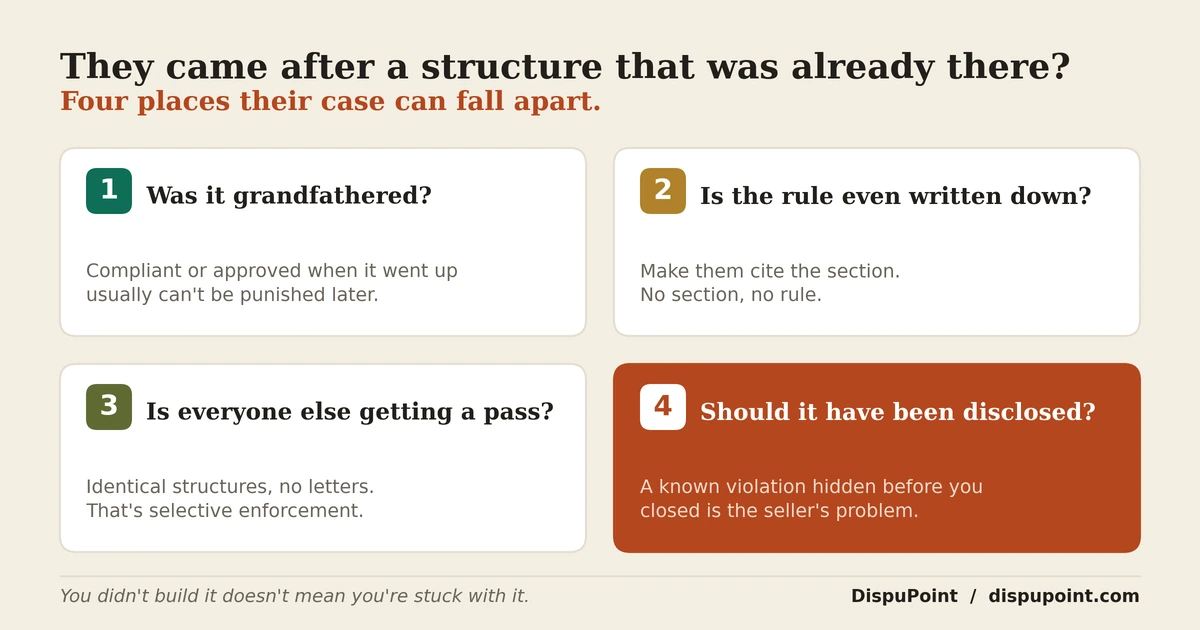
You bought the house for the yard. The fence was the whole point. Somewhere the dog could be a dog, somewhere the kids could be outside without you hovering at the curb. It was already standing when you signed, had been for years before you ever showed up. Then one random Tuesday a letter lands, and the HOA is denying a fence application. An application you never filed. For a fence you never built. They want it modified or torn out, and they're going to fine you for the privilege. Read that twice, because it's exactly as backwards as it sounds. Before you panic, and before you start writing checks, here's what nobody tells you: there are four places this whole thing falls apart for the board, and they're betting you won't check a single one. Selective enforcement is one lever the Illinois HOA laws hand you; the fence's own history is another.
Are You Even Responsible for Something You Didn't Build?
Start with the part that should spike your blood pressure. They're coming after you for a fence the previous owner put up, maybe a decade ago, that you inherited along with the mortgage. "It's your property now" is the line, and they'll deliver it like it ends the conversation. It doesn't.
A structure that was compliant, or properly approved, when it went up usually can't be dragged into a violation years later, not unless your governing documents specifically hand the board that power. That's grandfathering, and you check it before you so much as reply to them.
Honest caveat, because we don't deal in fairy tales. If the fence was never approved and the rule was already on the books when it went up, the grandfathering argument gets thinner. But if there's any paper showing it was permitted, or the association blessed it even once, that changes the whole picture. Don't roll over before you've looked.
Can They Actually Point to the Rule?
Here's where it gets good, because this is where most of these letters quietly die. A board can only enforce what's actually written down, in the declaration, the CC&Rs, or rules they adopted the right way. Not a feeling. Not "community standards." Not something a board member is pretty sure they remember agreeing to over coffee three years ago.
So when the letter says your fence is too tall, or it crosses some line past the middle of the house, you say four words back: show me the rule. Document, section, paragraph. Make them put a finger on it. One Illinois homeowner did exactly that, after getting hit with a fine that wasn't even on the association's own published fine schedule, and asked the board to point to where on earth it was authorized. Know what came back? Nothing. Silence. The fine just evaporated, because it was never standing on anything to begin with. That's not a trick. That's what happens when you ask a bully to produce the rule he's been waving around.
Are Other People Getting Away with the Same Thing?
Now walk your own neighborhood and count. Every fence like yours. Every deck, every shed, every thing that looks exactly like the thing they want to fine you over. If half the block has one and you're the only one holding a letter, that's not enforcement. That's a board that picked you. Under both the Common Interest Community Association Act (765 ILCS 160) and the Condominium Property Act (765 ILCS 605), going after one person while everyone else skates has a name and a defense behind it: selective enforcement.
So document it like you mean it. Photos, dates, addresses, the identical fence three doors down that's never gotten so much as a postcard. That isn't venting. It's the file you put in front of them when they ask why they should back off.
Why Is This Only a Problem Now That You Own It?
This is the one that really gets you, and you should sit in it for a second, because the timeline is on your side. There was a for-sale sign in that yard. There were listing photos, the ones with the fence in them, the ones you scrolled through and thought yes, this one. There were showings. There was a closing packet thick enough to stop a door. Every page of it datestamped to the day you signed. And the fence? Standing right there in all of it, plain as day, the whole time the association said absolutely nothing.
So you've got two different fights here, and they're not the same fight. The first one is with whoever sold you the house. In Illinois, sellers have to disclose known material defects under the Residential Real Property Disclosure Act (765 ILCS 77), and in a condo you're owed a resale disclosure package under 765 ILCS 605/22.1. If that violation was already sitting in the association's records and the seller knew, that datestamped paper trail, the disclosures, the docs, isn't just frustrating to look at. It's the spine of a claim against the seller, completely separate from anything the HOA does. That's a real, strong front, and most people never open it.
The second fight, with the board's years of silence, is more of an argument than a slam dunk, and you should know the difference before you swing it. A board that watched a fence for years and only now decided to care can face a "you slept on this" argument, and the singling-out ties straight back to selective enforcement. But here's the catch worth knowing up front: a lot of declarations carry a "no waiver" clause, language that says the board not enforcing for years doesn't cost it the right to enforce today. So the delay is a card you play, hard, and whether it wins comes down to what your specific documents say. Raise it. Just don't bet the house on it before someone's read the fine print.
Go Find the One Document Everyone Forgets About
Now go dig out your closing file. Somewhere in that brick of paper, if you bought a condo, there's a document most people sign without ever really reading: the resale disclosure the association is required to hand over under 765 ILCS 605/22.1. People call it the 22.1 letter, or the paid assessment letter. It's the moment the association itself put in writing what was owed and what was pending on the way into your purchase.
So pull it out and start asking yourself the questions they're hoping you never ask. Did the association sign one of these for my sale? What did it actually say was outstanding? Did it list a single word about this fence, this violation, this thing they're now telling me is a major problem? Because if the association had a formal obligation to lay out what was unresolved, and stayed silent about the exact issue it's now fining you over, that silence is worth a hard look.
Here's the honest boundary, so you don't overplay it. That letter is built around money and the shape of the association's finances, unpaid assessments, reserves, pending special assessments, lawsuits. It is not a clean bill of health on your unit's rule compliance, and a letter saying "assessments are current" does not mean "your fence is approved." An open violation on your specific lot doesn't always land in there. And this is a condo document; standalone HOAs under CICAA don't get an identical statutory packet, so if you're in an HOA, the questions shift to the seller's own disclosures and whatever your governing documents required. Either way, the move is the same: find the paper, read what it actually said, and ask whether they told you the truth when they had to.
What Does a Fine Actually Require?
Let's talk about the number on that letter, because they want you treating it like a bill from the electric company. It isn't. Before a fine sticks to you in Illinois, the board owes you written notice and a real chance to stand up and say your piece. Condos: 765 ILCS 605/18.4(l). HOAs under CICAA: 765 ILCS 160/1-30(g). Same floor, no exceptions.
Skip that, and the fine is procedurally defective, no matter what they claim you did. No notice, no hearing, no rule on paper, that's not a fine, that's a dare. And if they wave an appeal at you, take it, in writing, every single time. Make them do this by the book, because half the time they can't.
How to Get the Records You Need
You don't have to take any of this on faith, theirs or mine. You have a legal right to the records. For condos, 765 ILCS 605/19 gives the board 10 business days to hand them over after a written request, and blowing that deadline counts as a denial you can use. HOA records rights live in 765 ILCS 160/1-30.
Ask for three things, in writing, on the record: the exact rule and section they're leaning on, the approval history of the structure on your lot, and the enforcement history for every comparable structure in the community. That last one is how you turn "everyone else has one too" from a feeling into a selective enforcement record.
How to
Request the rule, approval history, and enforcement records from your HOA in writing
Send this letter to the association's managing agent or board secretary. Keep a copy and send it by email or certified mail so you have a delivery record. The response, or the silence, becomes part of your file.
[Your Name]
[Your Address]
[City, State, ZIP]
[Date]

[Association Name]
[Association Mailing Address]

Re: Written Records Request - [Your Property Address]

To the Board of Directors and/or Managing Agent:

I am writing to request the following records in connection with the enforcement notice dated [date of letter] regarding the structure at my property:

1. The specific provision(s), document name, article, and section, that the association is relying on to require modification or removal of the structure.

2. Any approval records, permits, or board authorizations for this structure, including any records predating my purchase of the property on [closing date].

3. Any enforcement actions, notices, fines, or approvals issued to other properties in the community regarding structures of a similar type (fences, decks, sheds, or comparable).

Please provide these records within the time period required under applicable Illinois law. I am happy to arrange inspection or copying at a mutually convenient time.

[Your Signature]
[Your Printed Name]
[Phone / Email]
Putting the request in writing starts the statutory clock, and a non-response or incomplete response is itself a documented failure you can point to at a hearing or in court.
That letter is step one.
You can send the above letter, or we can handle the whole case ourselves, from start to finish.
Get my free assessmentNo payment now. The $349 only starts your case if you act.
Where This Goes If the Board Won't Back Down
Maybe they fold the second you ask them to show their work. A lot of them do. But if you've drawn the stubborn kind, here's the ladder. Objection in writing. Show up to the hearing. Appeal in writing when they rule against you anyway. If that goes nowhere, your next stop in Illinois is the Condominium and Common Interest Community Ombudsperson at IDFPR, not the Attorney General, whatever the internet told you. After that, small claims for anything under its limit, and circuit court as the last resort, the one place a clean, documented file is worth its weight, whether you walk in solo or hand it to an attorney.
We won't promise you a win. Nobody honest can, and anyone who does is selling you something. What we do is move you off the back foot and toward the outcome you're actually after. We read your real governing documents against the letter they sent, find the holes they're praying you don't, sort out whether you're looking at a grandfathering problem, a missing rule, selective enforcement, or a disclosure that never happened, and build the record that makes them deal with you seriously. That's the difference between writing a check over a fence because you didn't know any better, and walking in with your case already made.
FAQ
Am I responsible for a fence violation if the previous owner built it?
Not automatically, no matter how confidently they tell you otherwise. The real question is whether the fence was compliant or approved when it went up, and whether your documents even allow retroactive enforcement. That means reading the actual declaration, not swallowing the board's version of it.
The fence was there when I bought the house. Why am I only getting a letter now?
Two things are worth chasing. If a known violation existed before closing and nobody disclosed it, you may have a claim against the seller under 765 ILCS 77, or the condo resale rules in 765 ILCS 605/22.1. And a board that ignored the fence for years before acting can face a "they slept on it" argument, though many declarations include no-waiver language, so it depends on your documents.
Doesn't the HOA have to disclose outstanding issues at closing?
For condos, yes, in part. Illinois requires a resale disclosure under 765 ILCS 605/22.1, often called the 22.1 or paid assessment letter, where the association states what's outstanding. But it centers on finances, assessments, reserves, pending claims, not a clean bill of health on your unit's rule compliance. Pull it from your closing file and read what it actually disclosed. Standalone HOAs under CICAA don't get an identical packet.
Should the fence violation have been disclosed when I bought the house?
Quite possibly. In Illinois, sellers must disclose known material defects under 765 ILCS 77, and condo buyers get a resale disclosure package under 765 ILCS 605/22.1. If a recorded violation was on file before you signed and nobody flagged it, that's a separate claim against the seller, regardless of how the HOA fight turns out.
What counts as selective enforcement by an HOA in Illinois?
It's when they come after you for something half the neighborhood is doing, untouched. It's a recognized defense under both CICAA and the Condominium Property Act. Photograph the comparable structures, with dates. A board enforcing a rule on exactly one person has a real problem explaining why.
Can an HOA fine me before giving me a chance to respond?
No. Both 765 ILCS 605/18.4(l) for condos and 765 ILCS 160/1-30(g) for HOAs require written notice and a chance to be heard before a fine takes effect. Skip that step and the fine can be challenged on procedure alone, before you ever argue whether you were right.
How do I request HOA enforcement records for a structure I didn't build?
Send this letter to the association's managing agent or board secretary. Keep a copy and send it by email or certified mail so you have a delivery record. The response, or the silence, becomes part of your file.