
Your board said no to your solar panels, and probably waved a covenant at you to end the conversation. Here's what they're counting on you not knowing: Illinois has a law that makes that no close to worthless, and the board members enforcing the ban have almost certainly never read it. Let me walk you through it.
What does Illinois law actually say about solar?
The short version: your board gets to say where the panels go, not whether they go up at all. Roof face, placement, how the array looks from the street, all fair game within limits. Refusing solar outright isn't. A flat ban doesn't survive this law, no matter which covenant they staple it to.
So when the denial letter shows up quoting some line about roof appearance, you're not stuck, you're being tested. Write back and ask them to point to the specific rule that bans solar, not just regulates it. They can't, because it doesn't exist. And even the regulating has a ceiling: they can nudge your panels to a different roof face, but not if it costs you more than about a tenth of what the system would produce.
Can my HOA ban a clothesline in Illinois?
Here I've got to be straight with you. Illinois has no law that protects clotheslines by name, none, and any blog that tells you otherwise is selling you a feeling. What it has is the solar law you just read, and the argument some owners make is that a clothesline runs on sunlight too, so it should count as a solar device and ride the same protection.
So that argument just wins? Not on its own.
No Illinois court has ruled on it, which means it might be right and it might not, and I'm not going to hand you a maybe dressed up as a fact. But a clothesline ban resting on nothing more than an old covenant, enforced by a board that never wrote the energy policy this law requires, is a lot weaker than the board wants you to believe. That's worth pushing on, as long as you push knowing it's an argument and not a settled right.
Why does the energy policy statement matter so much?
This is the single most useful thing in the article, so slow down here. Every association covered by this law is supposed to have a written energy policy statement, and it's got to give you a copy when you ask in writing. Most boards have never made one. They've been turning down solar and clotheslines for years off a covenant, with no policy behind it.
So watch what happens when you ask. You send one short written request for the energy policy statement. If it exists, now you know the exact rules you're working against, in writing, which already beats a vague no. If it doesn't exist, the board's been enforcing energy rules it never legally wrote, and that silence is the crack in the wall. Either answer moves you forward, which is why this one request does more than any angry email ever will.
How do I start the clock on my HOA in writing?
A board member saying no over the phone or across a meeting table isn't a decision you have to accept. It's an opinion, and opinions don't start clocks. Paper does. The moment your written request lands in their inbox, the law drops two deadlines on the board, and blowing past them stops being free.
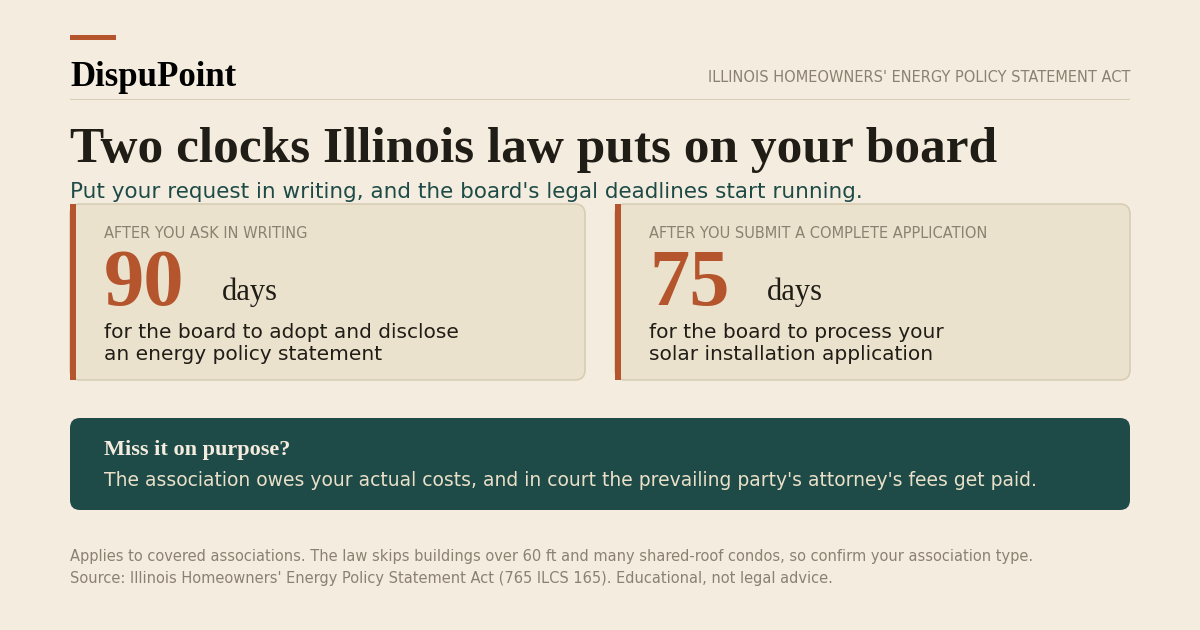
Here are the two clocks. From the day you ask, the board has 90 days to adopt and hand over that energy policy statement. From the day you file a complete application to install, it's got 75 days to answer you. If you apply before any policy exists, the 75-day clock waits until they write the policy, so ask for the policy and state your intent to install in the same letter, and start both clocks in one move.
How to
Ask your HOA for its energy policy statement, in writing
This letter is what starts the association's legal clock, so treat it that way. Save a copy, write down the date you send it, and send it a way that proves it arrived. If the board lets the deadline slide, that miss is now on the record with your name and the date attached to it.
[Date]

[Your Name]
[Your Address]
[City, IL ZIP]

[Association Name]
[Board or Management Address]

Re: Written Request, Homeowners' Energy Policy Statement

Dear [Board President or Property Manager Name],

Under the Illinois Homeowners' Energy Policy Statement Act, I'm requesting a copy of the association's current written energy policy statement.

I'm also letting the board know that I intend to submit a formal application to install [solar panels / an energy device] at my home at [your address]. Please send me the application process and any forms I need to use.

Please respond in writing within the time the law allows. I'm keeping a copy of this letter for my records.

Sincerely,
[Your Name]
[Phone / Email]
The day this lands, the board's response deadline starts running. If it blows past that deadline on purpose, the association can end up owing you money, and if the fight reaches court, the loser pays the winner's legal bill. A board that hears that from its own attorney usually stops stalling.
That letter is step one.
You can send the above letter, or we can handle the whole case ourselves, from start to finish.
Get my free assessmentNo payment now. The $349 only starts your case if you act.
What if the board just keeps saying no?
Say you do everything right and the board still digs in. Now you're not the one who looks unreasonable, they are, and you've got all of it in writing. A denial with no policy statement behind it, a ban the law already voided, a deadline they let slide, each one is a fact on your side, sitting in your inbox with a date stamped on it.
Here's the part that changes how a board behaves. If they willfully break this law, the association owes you the actual money their stalling cost you. And if it goes to court and you win, they pay your legal bill, not only their own. Read that twice. A board that would happily shrug off one homeowner suddenly has its own attorney explaining that digging in could mean cutting you a check, and that math ends most of these standoffs long before a courtroom.
You don't have to run this alone, and you don't have to sue anyone on day one. Plenty of these turn the moment the board realizes you've actually read the statute and they haven't. A demand letter is one way to force that moment. So is simply sending the requests, on paper, with the dates saved.
FAQ
How do I request an energy policy statement from my Illinois HOA?
Send a short written note to the board or property manager, name the Illinois Homeowners' Energy Policy Statement Act, and ask for the association's current written policy. Date it, keep a copy, and send it a way that proves delivery. From that date, the board's on a legal clock to produce the policy, and a miss counts against them.
Can my Illinois HOA ban solar panels outright?
No. A flat ban on solar doesn't hold in Illinois, and neither does a covenant written to reach the same result a quieter way. The board can regulate where panels sit and how they look, within limits, but it can't tell you no solar at all. If your board's enforcing a total ban, it's standing on losing ground.
Does Illinois law protect clotheslines?
Not directly. Illinois has no right-to-dry law. The argument that a clothesline counts as a solar device under the state's solar law is real but untested in an Illinois court. Still, a clothesline ban backed only by an old covenant, with no energy policy statement behind it, is worth challenging. Treat it as a strong argument, not a sure thing.
How long does my HOA have to answer a solar application?
Seventy-five days to process a complete solar application, counted from the day you submit it. Separately, the board has 90 days to adopt an energy policy statement once you ask for one. If you apply before any policy exists, the 75-day application clock doesn't start until the board writes that policy.
Do these rules apply to condos in Illinois?
Often not, and this trips people up. The law skips buildings over 60 feet tall and many buildings with a shared roof under an association, which covers a lot of condos. A condo governed by the Illinois Condominium Property Act may fall outside this law entirely. Check your building type and documents before you lean on any of it. Which of the Illinois HOA laws covers your building decides whether the energy rules apply at all.