
Somewhere in Illinois right now, a homeowner is on hold, trying to reach the state agency that regulates HOA boards. I get the instinct. When your board starts throwing its weight around, it feels like somebody official has to be watching. Here's the uncomfortable part: almost nobody is. That's a long way, though, from saying the board can't be touched. What does hold a board accountable, under the Illinois HOA laws, is the statute itself and the paper trail you keep.
Does anyone in Illinois actually regulate HOA boards?
There's no HOA police. I'll say it plainly, because homeowners lose real weeks hunting for someone to call. If your community runs under the Illinois Common Interest Community Association Act, the one everybody shortens to CICAA, there's no licensing board sitting over your directors, no state enforcer, no hotline that can order them to behave.
So they can just do whatever they want?
No. The law hands you tools. It just doesn't gift-wrap them, and it won't come knocking to ask if you need them.
What does CICAA actually demand of a board?
More than most boards act like it does. CICAA requires your board to follow the association's own governing documents, keep meetings open to owners, let owners inspect the records, and stay inside the powers the declaration actually grants. That last one carries more weight than it sounds like.
Picture a board that decides one evening nobody can park a pickup in their own driveway. Petty, sure. But go read the declaration. If it never handed the board that power, the board didn't pass a rule, it invented one it can't enforce. A board voting itself authority it was never given, or refusing to open the books, isn't operating inside the law. It's operating outside it, and outside the law is exactly where you can challenge them.
Who can actually force the board's hand?
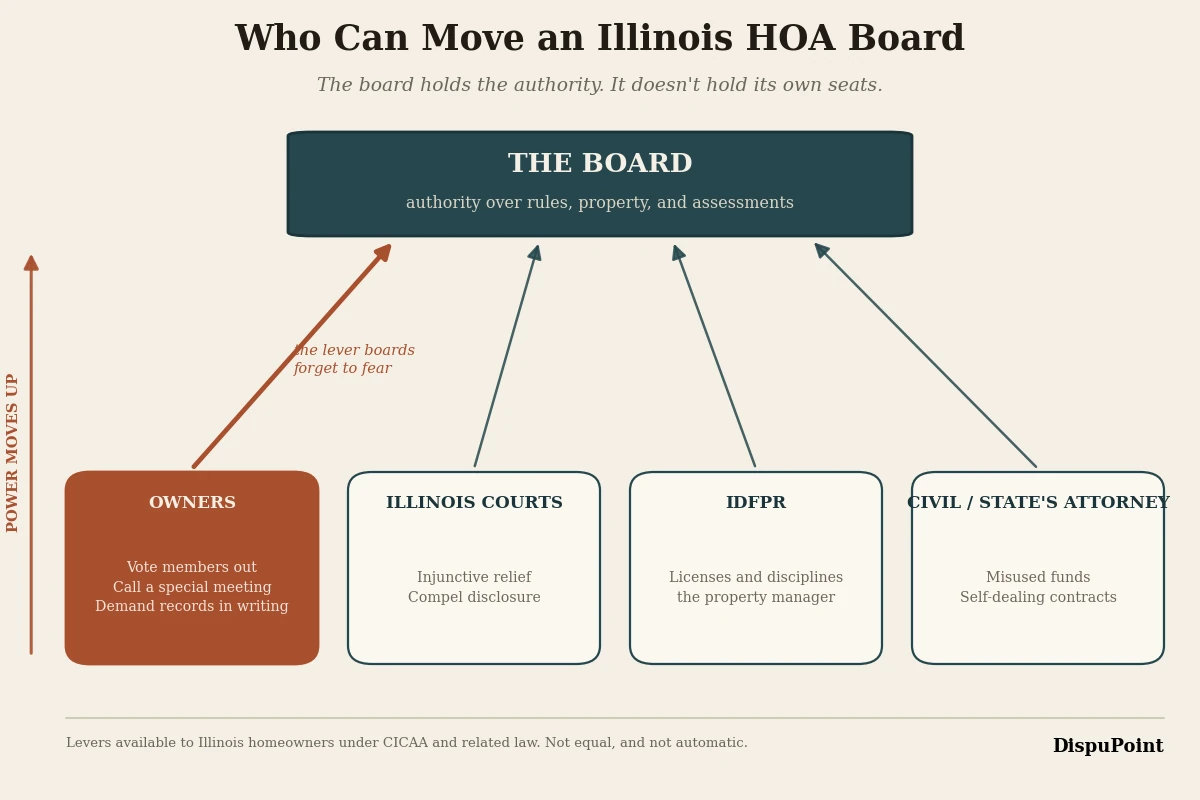
Four levers exist. They aren't equal, and knowing which one to reach for first is half the fight.
Start with the owners, because that's you and your neighbors, and it's the lever boards forget to be scared of. Just because a board's got control of the room doesn't mean it's untouchable. They hold the gavel. They don't hold their own seats - you do. CICAA lets owners gather signatures, call a special meeting, and vote directors out. Your bylaws set the bar, usually somewhere between ten and twenty percent of owners to force that meeting. Boards get removed this way more often than they'd ever admit out loud, and a board that feels the room turning tends to get cooperative fast.
Then there are the courts. Illinois circuit courts hear CICAA disputes, and a suit for injunctive relief can freeze a board action cold or drag documents into daylight. It's slower, it costs money, but it's real, and the attorneys and paralegals who work in community association law take these cases when a violation is clean enough to win.
If a licensed property management company runs your association, you've got a third option. The Illinois Department of Financial and Professional Regulation, IDFPR, licenses those managers. A complaint there won't reach into your board and fix it directly, but it can land on the management company and the licensed people under it, and that tends to concentrate minds.
The fourth lever only opens in narrower cases. When association money is walking out the door - self-dealing contracts, funds moving with no explanation, billing that isn't honest - you've crossed out of a community squabble and into the territory of civil litigation, and in the worst cases, a state's attorney.
What's the fastest lever you actually have?
Ask for the records. In writing. It isn't dramatic, but nothing moves quicker as an opening shot, and how the board answers tells you almost everything about what you're up against.
A board that's bending the rules, or slow-dancing right along the ethical line, wants the paperwork to stay invisible. So put a written records request in front of them, one that cites CICAA and names exactly what you want. A grounded letter - real dates, the specific obligation, the documents you're owed - reads nothing like the frustrated emails they've gotten good at ignoring. It's a lot harder to delete and pretend they never saw it.
And if it turns out one of your directors is a lawyer? Better still. They'll recognize what they're holding faster than anyone else at that table. The second you write to them in a language they actually speak, they understand the math has shifted. They're not dealing with someone who'll wear out and go away. They're dealing with someone working with their eyes open.
Here's the mechanism that gives it teeth. Under CICAA, an association has to make records available within thirty days of a written request. Blow past that, and the board hasn't just been rude, they've handed you a clean statutory violation, the kind a court doesn't have to squint at. No "the board has discretion." A missed deadline is a missed deadline.
How to
Request your HOA records in writing under CICAA
Send this to your board or management company by certified mail, or by email with a read receipt. It starts the thirty-day clock and builds the paper trail you'll want if this has to escalate.
[Your Name]
[Your Address]
[City, IL ZIP]
[Date]

To: [HOA Name] Board of Directors / [Management Company Name]
Re: Formal Records Inspection Request Under the Illinois Common Interest Community Association Act

Dear Board Members,

I'm an owner at [Address / Unit Number] in [Association Name]. Under the Illinois Common Interest Community Association Act (CICAA), I'm requesting access to and copies of the following association records:


All financial statements and budgets for [date range]
Minutes of all board meetings for [date range]
The current executed management agreement, if any
[Any other record you want - contracts, invoices, the reserve study]


Please confirm you've received this request and let me know the date, time, and manner in which the records will be made available. I understand the association has thirty days to respond.

Sincerely,
[Your Name]
[Phone / Email]
This letter starts CICAA's thirty-day clock. If the board ignores it, that silence becomes a clean violation you can carry into court.
That letter is step one.
You can send the above letter, or we can handle the whole case ourselves, from start to finish.
Get my free assessmentNo payment now. The $349 only starts your case if you act.
FAQ
Who regulates HOA boards in Illinois?
No single state agency regulates HOA boards directly. Illinois homeowners associations run under CICAA, which sets real legal obligations but leaves enforcement to owners and the courts. If your association uses a licensed property manager, IDFPR regulates that manager and accepts complaints against licensed personnel.
How do I request HOA records in Illinois?
Send a written request to your board or management company by certified mail or email. Under CICAA, your HOA has thirty days to make the records available. Ask specifically for financial statements, meeting minutes, and any contracts you want to see, and keep a copy of the request with proof of delivery.
Can Illinois HOA board members be removed?
Yes. CICAA and your bylaws set the path. Owners usually need signatures from a set percentage of the membership to call a special meeting, then hold a vote to remove. Your bylaws spell out the exact threshold and procedure for your association, so start there.
What can I do if my HOA board is ignoring the rules?
Start with a written records request. It documents what's happening and forces a response. If the board breaks a specific CICAA obligation, like blowing the records deadline or closing a meeting it had no right to close, you can bring a civil action in an Illinois circuit court. An attorney who handles community association disputes can tell you whether your facts are strong enough to sue.
Does CICAA or the Illinois Condominium Property Act govern my community?
If you own a house or townhouse in a community association, you're probably under CICAA. If you own a condo unit, you're probably under the Illinois Condominium Property Act, which carries its own rules and shorter deadlines. Your deed and the association's declaration name the statute that controls.
FAQ
How do I request HOA records in Illinois?
Send this to your board or management company by certified mail, or by email with a read receipt. It starts the thirty-day clock and builds the paper trail you'll want if this has to escalate.