
The fine was five hundred dollars. The fight lasted years and climbed all the way to the Illinois Supreme Court's doorstep. Do that math for a second, because the math is the whole point. Nobody spends years and a fortune in legal fees to get five hundred dollars back. Michael Boucher wasn't fighting for the money. He was fighting because his condo board fined him for opening his mouth, and he refused to let that stand.
That's the case every Illinois condo owner should know by name: Boucher v. 111 East Chestnut Condominium Association. And here's the part the law firms bury when they write about it. Boucher was, by the court's own description, a difficult man. Profanity at staff. Yelling in elevators. Exactly the resident a board fantasizes about silencing. It didn't matter. The board still had to follow the law, and the court said so.
But Boucher had something most owners don't. He could afford to be right. That's the real story here, and it's the one nobody tells you.
The board is betting on the math
Here's how the bet works, and boards make it on purpose.
They fine you a few hundred dollars for something that's wrong to fine you for. You're furious. You look into fighting it. A lawyer to take an HOA dispute starts in the thousands, sometimes well into the thousands, against a fine worth a few hundred. The numbers don't even pretend to work. So you do what almost everyone does. You pay it, you stew, and you let it go.
The board knows you'll do that. That's where the audacity comes from. The fine isn't really about the fine. It's a test of whether you'll push back, and they've already guessed you won't, because being right costs more than being quiet.
Boucher broke the bet because he had the resources to take it the distance. Most owners never get that chance. The principle dies in the gap between "this is wrong" and "I can't justify the cost of proving it." That gap is the most important thing in this entire story.
Your board can't fine you just for criticizing them
So what did Boucher's stubbornness actually establish? Something that now protects you, whether or not you ever go near a courtroom.
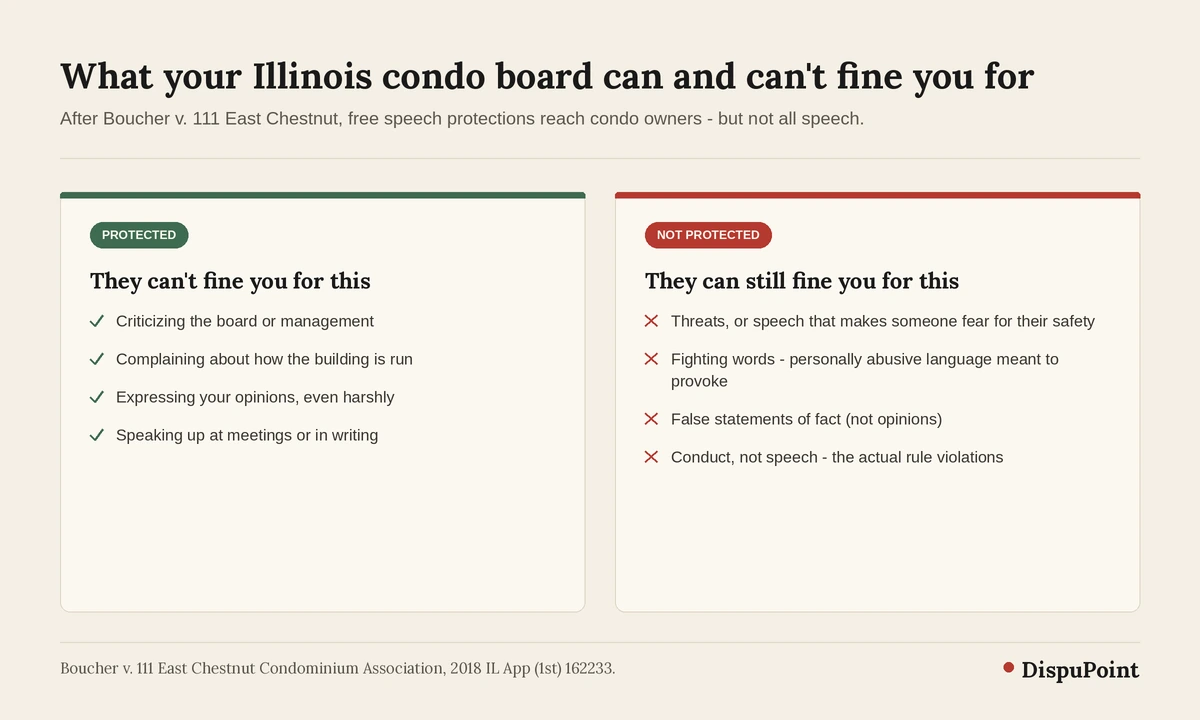
In Illinois, a condo association can't enforce rules that punish you for your speech, even though the association isn't the government. Criticizing the board. Complaining about management. Saying out loud that the building is run badly. Protected. A board that fines you for it is standing on the wrong side of the law.
Be precise about what the case is, though, because precision is leverage. The trial court threw Boucher's case out. The appellate court revived it and sent it down for trial, and the Illinois Supreme Court declined to disturb that. So the principle is settled law. Boucher's own case went back down to be fought out. The ground you stand on is solid; what you build on it is up to you.
Now the honest limit, because I won't sell you a fantasy. This protection isn't a blank check. Threats aren't covered. Speech that makes someone fear for their safety isn't covered. Fighting words, the personally abusive kind meant to provoke, aren't covered. And false statements of fact aren't opinions. You can call the board incompetent all day. You can't invent a lie that the treasurer is stealing. Know the line.
The case quietly handed you two more things
Free speech is the headline. Boucher did two more things that help owners.
First, records. The board ran Boucher's hearing behind a closed door, recorded it, then refused to give him the recording. The court treated that recording as the record of the meeting, and owners have a right to those records. Closed-door doesn't automatically mean off-limits. If you've never pulled your association's records, that's leverage sitting unused, and I wrote up how to do it here.
Second, candor. Before a board penalizes you, it owes you an honest look at the evidence against you. And the court said the part boards hate: the business judgment rule and the fine print in the declaration do not protect a board that acted in bad faith. "We had the authority" is no answer to "you hid the evidence and punished me for complaining."
Where the fight is actually won, and lost
I'll tell you where I sit. I'm on a condo board. I read this case from both chairs, and from the board side it's a warning, not a comfort. The board in this case had a difficult owner and a paper trail, and they still lost the principle, because they treated rules as a weapon instead of a process. They fined first and justified later.
But here's what I keep coming back to. Boucher won the principle in a courtroom, after years, because he could pay to get there. The version of this fight that actually works for normal people happens way earlier, long before a courtroom is on the table. It happens the first time the board oversteps, when an organized, specific pushback either ends the dispute or forces the board to show its hand.
Most owners never make that early move, because they don't know what their leverage is and they assume the only options are pay the fine or hire a lawyer. There's a whole stretch of road between those two, and it's where most disputes are actually settled.
That stretch is exactly the gap DispuPoint was built for. Not a lawyer on retainer, not a template you fill in and hope. A real read of your specific dispute, the leverage you didn't know you had, and a demand letter that names it, prepared for you to send. Human-reviewed, flat fee, sized for a fight that's about a few hundred dollars and a principle, not a life-altering sum. The point isn't to win you a lawsuit. It's to make being right affordable enough that you don't have to fold.
How to make the board cite the rule in writing
The early move starts with one request. It builds the paper trail, and it forces the board to either produce a real rule or admit there isn't one.
How to
Ask the board to cite the exact rule behind a fine for something you said
Send this to your property manager or board president by email or certified mail. Keep a copy. Use it when you've been fined or warned over speech - a complaint, a criticism, an opinion - rather than over conduct.
[Date]

To: [Board President Name / Property Manager Name]
[Association Name]
[Association Address]

Re: Written Request - Rule Basis for Violation Notice dated [date]

Dear [Name],

On [date], I received a violation notice and fine in connection with [describe what you said or wrote].

I am requesting, in writing, the specific rule or declaration provision the association relies on as the basis for this notice, including where it is recorded and when it was adopted.

I am also requesting copies of the records and evidence the board relied on in issuing this notice.

Please respond in writing.

Sincerely,
[Your Name]
[Unit Number]
[Your Contact Information]
It moves the board off "we said so" and onto the record. Either they cite a real, adopted rule, or they can't - and either answer tells you exactly where you stand.
That letter is step one.
You can send the above letter, or we can handle the whole case ourselves, from start to finish.
Get my free assessmentNo payment now. The $349 only starts your case if you act.
FAQ
Can an Illinois condo board fine me for criticizing the board?
Generally no. Under the reasoning in Boucher v. 111 East Chestnut Condominium Association, a condo association can't enforce rules that punish you for protected speech, including criticizing the board or management. The protection has limits: threats, fighting words, and false statements of fact are not covered.
What is Boucher v. 111 East Chestnut Condominium Association?
It's a 2018 Illinois Appellate Court decision involving a Chicago condo owner fined after criticizing his board. The court held that free speech protections reach condo owners, that boards must produce certain hearing records, and that a board owes owners honest disclosure before penalizing them. The Illinois Supreme Court declined to disturb it.
If the fine is small, is it even worth fighting?
That's the exact bet a board is making when it fines you for speaking up. A few hundred dollars rarely justifies a lawyer, so most owners pay and move on. The affordable middle is an organized early pushback - a written demand that names your leverage - which can resolve a dispute long before lawyer-level cost is ever on the table.
My board ran my hearing in a closed session. Can they hide the recording?
Not necessarily. In Boucher, the board recorded a closed disciplinary hearing and refused to share it. The court treated that recording as the record of the meeting, which owners have a right to access. Closed-door doesn't automatically mean off-limits.
What should I do first if I think a fine is retaliation?
Put everything in writing and ask the board to cite the exact rule you supposedly broke. Save every notice with dates, and keep your own complaints documented. A retaliatory fine usually can't be tied to a clean, adopted rule, and the written request is what surfaces that.
Source: Boucher v. 111 East Chestnut Condominium Association, 2018 IL App (1st) 162233
How do I make my condo board prove a fine is based on a real rule?
Send this to your property manager or board president by email or certified mail. Keep a copy. Use it when you've been fined or warned over speech - a complaint, a criticism, an opinion - rather than over conduct.