Free assessment, then $349 · Illinois HOAs and condos · Human-reviewed
Your free assessment, then what $349 buys.
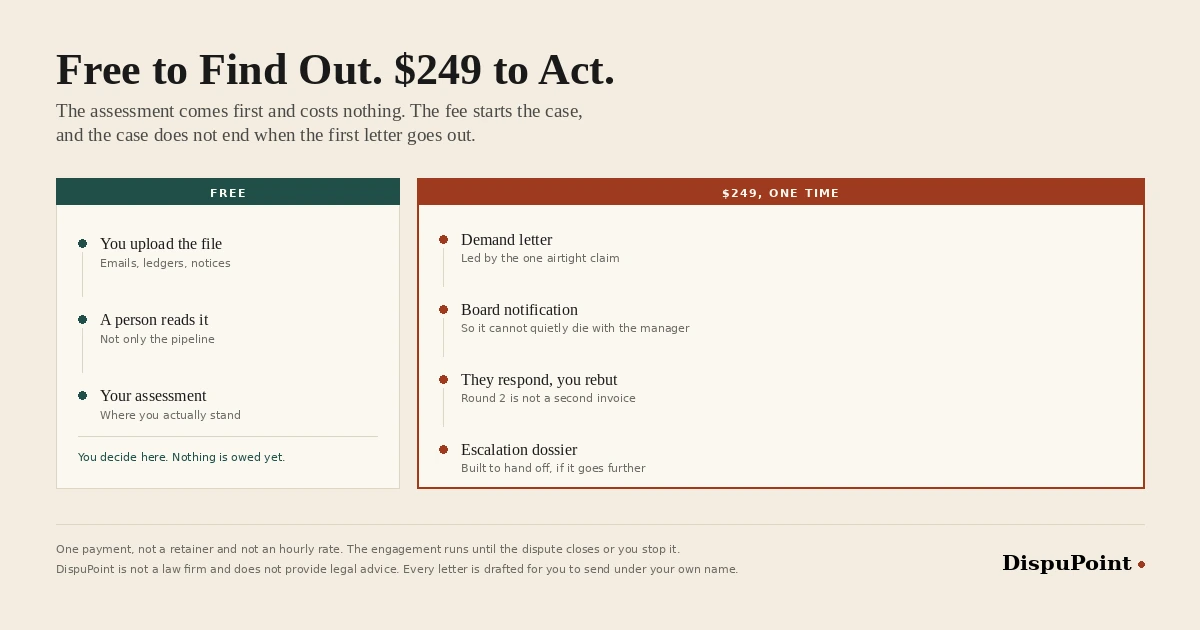
Everything the flat fee covers, from detailed findings to escalation dossier.
Most homeowners imagine one of two things. A generic form letter for a hundred bucks, or a lawyer on retainer for a few thousand. DispuPoint is neither. Tap any document below to see what's inside.
tap or click any card to flip it
First · we read your file
Before any letter gets written, someone actually reads your case.
You upload your file. The emails, the ledgers, the portal screenshots, the fee schedules, the letters you've already sent. The DispuPoint pipeline reads all of it. Then I read it. Then you get a Case Assessment, free, the document that pulls everything into one place and tells you, in plain English, what you're sitting on.
The Assessment is yours, and it costs nothing. It walks you through what your documents show, surfaces the patterns that matter, and points to the specific evidence behind each one. You see exactly where you stand before you decide whether to start the case. You decide what to do with it.
Document 1 · The Case Assessment
"Nicole, I've gone through everything you sent us, and the picture is clear."
A plain-English letter that opens with where you stand, walks through the evidence, names the rules that apply, and tells you what we'd suggest as a next step. Written from scratch against your file. Not a template.
Excerpt · redacted
"Here is the most important thing in your favor. A XXXXX staffer put it in writing on April 25, 2025, that the $250 transfer fee 'is not specified in the association's rules and regulations.' That is their own employee, in writing, admitting the fee has no basis in the governing documents. They charged it anyway, continued demanding it, and have never retracted that statement."
Then · the letters that go out
Three letters, in the order they go out.
The demand letter is the main event. It's the document the other side actually responds to. But a strong case usually needs more than one letter, because the management company isn't the only party with a stake. Each letter goes out under your name, on your signature. Here's the order things happen in.
Goes out first
The Demand Letter
Sent to the management company. Names what's wrong. Cites the documents in their own file that show it. Sets a written response deadline.
Goes out in parallel
The Board Notification
A separate letter to the condo or HOA board. Different tone. Different goal. Keeps the board from being the place where things go to disappear.
After they reply
The Resolution Letter
Drafted after they respond. Closes out what they conceded. Sets up the next move on what they didn't. Round 2 is included.
Document 2 · The Demand Letter
"Dear XXXXXX:"
A formal demand laying out each issue, the specific evidence, and what you're asking for. Every claim ties to an exhibit. Every exhibit is a document the other side produced. You sign it. You send it.
Excerpt · redacted
"Between April 14 and April 25, 2025, XXXXX charged my account four fees totaling $775. On April 17, 2025, I paid $206.98 toward that balance, documented by my credit card statement with reference number XXXXXX. That payment does not appear anywhere on the current ledger."
Plus · the exhibits
Every claim, anchored to a document the other side produced.
Each letter ships with the supporting documents pulled, labeled, and attached. The other side can't claim they weren't on notice of what's being relied on, because the letter quotes each exhibit and points to where it came from. Tap any tile to see the kind of document it carries.
Tap an exhibit above
Each exhibit type is built from documents you uploaded. Names, dates, and amounts get scrubbed in this preview. Yours arrives intact.
Case brief and statute citations
Inside the case file you also receive a separate document we call the case brief: a plain-language summary of the dispute, the violations, the statutes cited, and the timeline of events. It's built to work as a hearing outline if you end up in a Cook County small claims courtroom.
If needed · the escalation dossier
If the letter doesn't move things, you already have the forms.
You may never need this. But when the company stalls, or the issue turns out to be bigger than one account, you need somewhere to go next, and you need it assembled before you're in a hurry. The escalation dossier assembles three Illinois forms from your case file. You review them, decide which ones to file, and sign them yourself.
Tap a form above
Each form arrives assembled from the facts in your case file. You review, edit if needed, and file yourself if you choose to.
What this is not.
DispuPoint is not a law firm and does not give legal advice. The Case Assessment is a plain-English read of your documents, not a legal opinion. The letters are drafted for you to send under your own name, not on legal-firm letterhead. The forms come assembled from your case facts, but you decide whether to file them.
If your case needs a lawyer, the Assessment will say so, and you'll leave with an organized file an attorney can pick up rather than rebuild. That's the line.
One case. Free assessment, then $349. Nothing automated gets sent.
Get my free assessmentReviewed by Gaston Sitbon, DispuPoint
DispuPoint is not a law firm and does not provide legal advice. No attorney-client relationship is formed by reading this page or by using the DispuPoint service. For legal advice specific to your situation, consult a licensed legal professional in your state.