
Three broken things crossed my desk this month. A client's garage door mechanism quit cold. Somebody else's windows blew out in the wind. My own building took on water after the rain wouldn't stop. Different buildings, different damage, and every single time the same sentence landed in somebody's inbox: "that one's on you."
I keep a file of these. It's past 700 disputes now. And the thing that breaks isn't usually what the fight's actually about. The fight's about one word nobody nailed down at the start: who.
Because here's what most owners do when the board says pay up. They pay up. They never ask the only question that matters, which is where, exactly, does it say that. This is the part most owners get wrong. So let me walk you through it.
What is a limited common element?
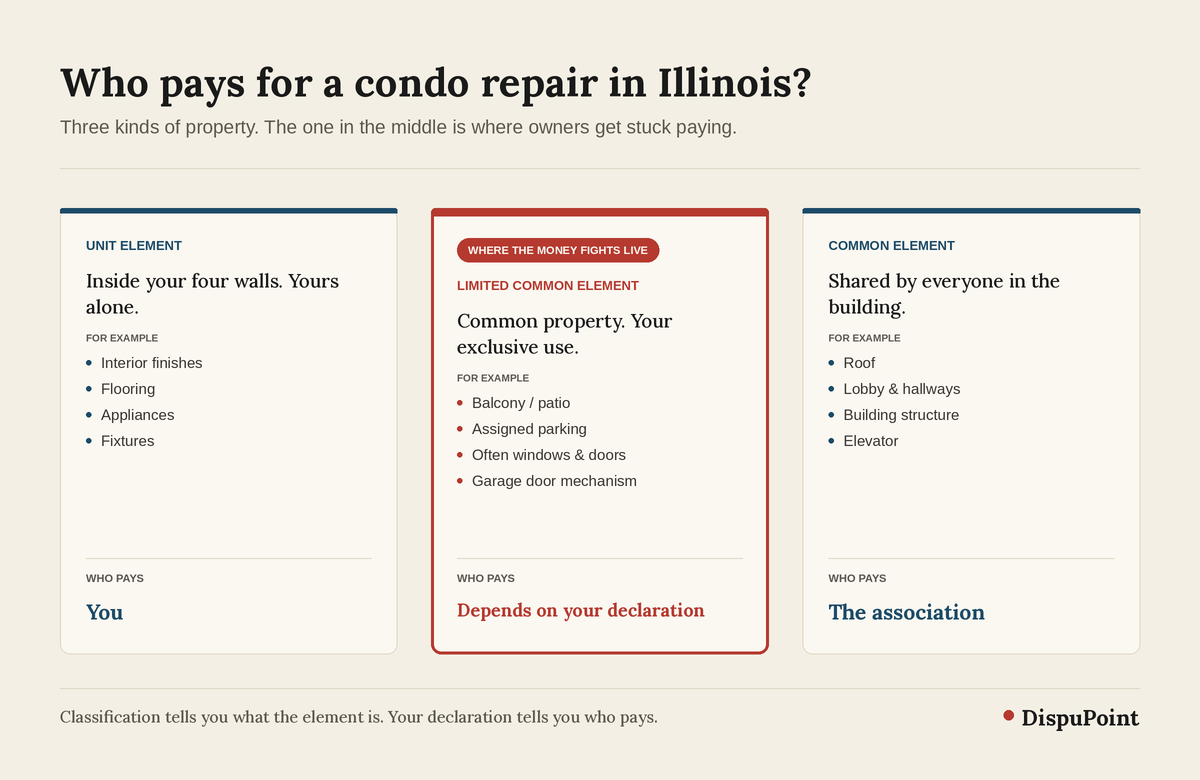
A limited common element is shared building property set aside for one owner's exclusive use. Your balcony. Your assigned parking space. Usually your windows and exterior doors. Often the garage door mechanism. Nobody else touches it, but on paper it still belongs to the association, not just to you.
That word "limited" is doing a lot of work, and it trips people up. So here's the whole map.
Illinois condo property comes in three kinds. A unit element is yours alone - the finishes, the flooring, the appliances, everything inside your four walls. A common element is the opposite - the roof, the lobby, the hallways, the structure itself, shared by everyone and paid for out of everyone's assessments. The limited common element sits in the middle: common property, your exclusive use. The Illinois Condominium Property Act sets up these buckets. Your declaration fills in the details.
The first two are usually clean. The middle one is where the money fights live.
So who actually pays?
Here's the trap. People assume "limited common element" answers the who-pays question. It doesn't.
Classification tells you what the thing is. It says nothing about who fixes it. Those are two different questions, and your declaration answers them separately. One building puts balcony structure on the association and the glass door on you. Another splits window repair from window replacement. A third dumps the whole category on owners. There's no universal rule. There's only your document.
I learned this the boring way, reading the same kind of clause in my own building's documents at a kitchen table at eleven at night. Nobody hands you this. You go find it.
Why storms are when this blows up
Storms hit the gray zone on purpose. Not the gray zone by choice - the gray zone by physics. Wind and water go for the edges of a building, and the edges are exactly where "clearly yours" and "clearly theirs" stop being clear.
Look at what actually breaks. In the disputes I track, the elements that come up most aren't the dramatic ones. Roofs lead, showing up in 66 of them. Garages in 47. Windows in 33. Balconies, decks, patios behind those. The unglamorous seam where your unit meets the building. That seam is where boards give fast answers based on habit, and where owners pay for repairs the declaration never put on them.
I've watched it twice this season alone. A window someone got charged for that wasn't theirs. Water damage where the board insisted it wasn't their problem. Same shape every time. Board asserts. Owner believes. Money moves the wrong direction.
Make them cite the document
So don't believe them. Not out of paranoia. Out of process.
When the board tells you a repair is yours, ask them to show you the exact provision that says so. Not a summary. Not "per the rules." The actual language, section and all. Same when they tell you which vendor you have to use, or hand you any rule you can't find written down anywhere.
Two things happen when you ask, and you win on both. Either they produce the provision, and now you actually know where you stand instead of guessing. Or they can't produce it, and the confident answer they gave you turns out to be air. Either beats writing a check for something that was never yours.
As an owner you've got the right to inspect your governing documents. Put the request in writing and keep a copy. If you want the longer version of how to pry records loose from a board that drags its feet, I wrote that up here.
How to ask for it in writing
A short written request does two jobs at once. It builds a paper trail, and it forces a specific answer instead of a shrug.
How to
Request the declaration provision behind a repair ruling in writing
Send this to your property manager or board president by email or certified mail. Keep a copy. Works whether you're contesting a charge you already paid or pushing back before you pay a dime.
[Date]

To: [Board President Name / Property Manager Name]
[Association Name]
[Association Address]

Re: Written Request - Declaration Provision for [Describe Element, e.g., "balcony door repair" or "garage door mechanism"]

Dear [Name],

On [date], I was informed that the repair cost for [describe the element and damage] is my responsibility as a unit owner.

I am requesting that the association provide, in writing, the specific section and language of the Declaration of Condominium Ownership that assigns responsibility for this repair to unit owners rather than the association.

I am also exercising my right to inspect the relevant governing documents if needed.

Please respond in writing.

Sincerely,
[Your Name]
[Unit Number]
[Your Contact Information]
A written request creates a timestamped record the board has to answer, and it moves the conversation from "we said so" to "here's where the document says so."
That letter is step one.
You can send the above letter, or we can handle the whole case ourselves, from start to finish.
Get my free assessmentNo payment now. The $349 only starts your case if you act.
FAQ
What is a limited common element in an Illinois condo?
A limited common element is shared association property reserved for one owner's exclusive use - balconies, assigned parking, often windows and exterior doors. The Illinois Condominium Property Act defines the category, but your own declaration decides exactly what qualifies in your building and who pays to repair it.
How do I ask my condo board to show me where the rules say I owe a repair?
Put it in writing. Ask the board or property manager to cite the exact section of the declaration that assigns the repair to you. You've also got the right to inspect the governing documents yourself. Verbal answers are hard to challenge later. Written ones aren't.
Does "limited common element" mean the owner always pays for repairs?
No. Classification and payment are separate questions. Your declaration answers the payment one. Some declarations put limited common element repairs on the association, some split them, some put them on the owner. There's no single rule that covers every building.
My board told me verbally that my windows are my responsibility. Do I have to take their word for it?
No. Ask them to put it in writing and cite the declaration provision. If they can't point to specific language, their verbal position has nothing behind it. Boards state rules confidently all the time that turn out not to exist in the actual documents.
What if my declaration is unclear about who pays for a limited common element repair?
Genuinely ambiguous language is contested territory. Start by reading the full maintenance and repair section, not just the definitions. If it still doesn't resolve, a review by a condo attorney can help - and sometimes the ambiguity itself is worth raising formally with the board.