
I have read a lot of condo bills. The one with a window you don't own is my favorite kind of wrong.
Here is how it usually goes. You open your statement, and there it is: a charge for window work, big number, no breakdown. You squint. Two of those windows are yours. The third one is out in the hallway, the one the whole floor walks past every day. You never touched it. You can't touch it. And somehow it landed on your bill.
I built DispuPoint after spending the better part of a year fighting my own management company, so I know this particular runaround from the inside. Under Illinois condo law, a hallway window is almost certainly not yours to pay for. And you have more leverage than they are counting on.
First, before you read another word, do this.
What counts as a common element in an Illinois condo?
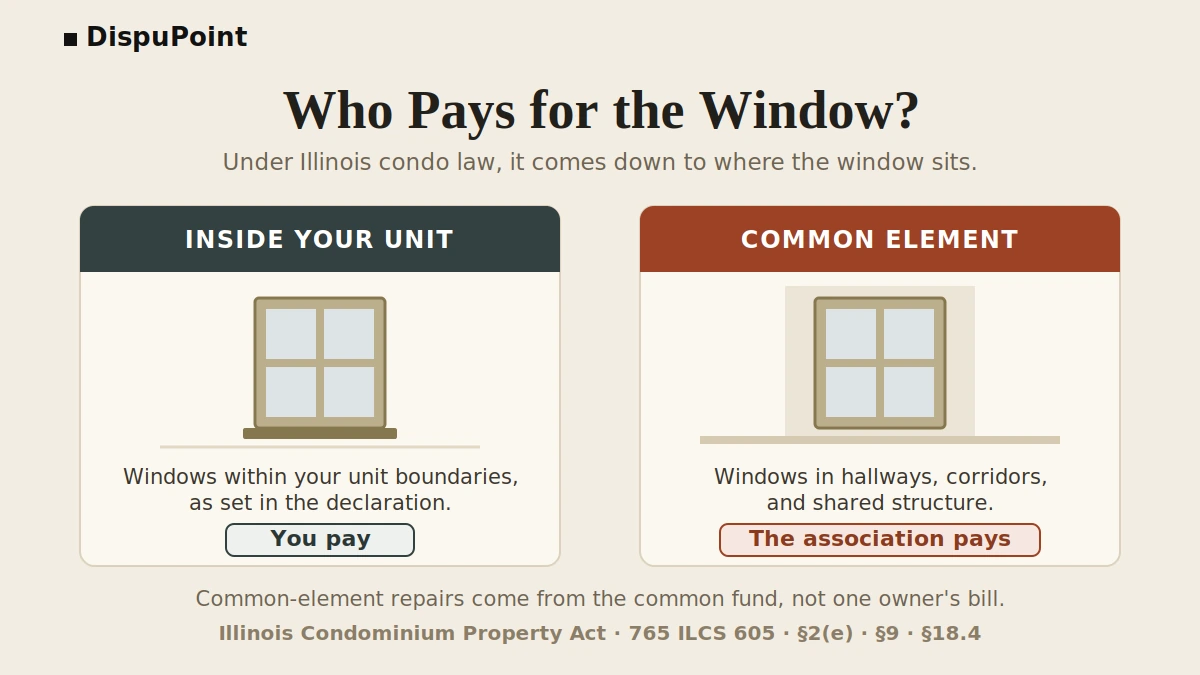
Here is the line that matters. Under the Illinois Condominium Property Act (765 ILCS 605), Section 2(e) says a common element is everything that is not inside your unit. Hallways, corridors, stairwells, the structure that holds the building up. A window sitting in a shared hallway is about as common-element as it gets.
Your declaration can draw the boundary in odd places, which is why you pulled it. But the default in Illinois leans hard one way: if it is out in the hall, it is the building's problem, not yours.
So why did it land on your statement? Two possibilities, and one of them should make you angry.
Why your condo association can't put a common element on your bill
Section 18.4 of the Act puts the duty to maintain and repair common elements on the board, paid for out of the common fund. That is the pot everyone pays into through assessments. The board cannot take a common-element expense and quietly slide it onto one owner's individual ledger.
Section 9 backs it up. Your assessment is supposed to track your actual share of common expenses, set by the declaration. Billing you alone for a window the whole floor uses does not square with either section.
Now the boring truth: sometimes this is just a screwup. A property manager miscounts. A scope of work gets typed up wrong. Fine. But here is the part that should bother you. In the cases I see, the manager admits it on the phone, says they will look into it, and then nothing changes. The bill still says three windows. A verbal "my bad" does not fix your account.
Which means you need something a phone call can never give you.
Can you demand an itemized condo assessment?
Yes, and this is the lever most owners walk right past. Section 19 of the Act (765 ILCS 605/19) gives you the right to inspect and copy the association's books and records, including the itemized money behind any charge on your account. Handed a bill over a thousand dollars for window work with no line items? You can demand the breakdown in writing.
The clock matters here. Once you send a proper written request, the board has 10 business days to produce the records. Miss that window, and the statute treats the silence as a denial. That is leverage you do not get by leaving another voicemail.
So stop waiting for the manager to fix it out of the goodness of their heart. Put it in writing. Here is the letter.
How to dispute a condo special assessment in writing
This is where most people lose. They call, the manager agrees it sounds wrong, nothing happens, and then a late fee shows up riding on top of the original mistake. A written dispute is different. It creates a record the board has to answer.
How to
Dispute an improper window assessment in writing
Send this to your property manager and copy the board president. Keep a timestamped copy. If you email it, ask for a read receipt and follow up by certified mail.
[Date]

[Your Name]
[Unit Number and Building Address]

[Property Manager Name]
[Management Company Name]
[Address]

Re: Dispute of Window Assessment - Account for Unit [Unit Number]

Dear [Property Manager Name],

I am writing to formally dispute a portion of the window assessment on my account dated [date of bill]. The bill charges me for three windows, but only two of them are within the boundaries of my unit as described in the declaration.

The third window, [describe location - e.g., "the window in the [floor] hallway next to my unit"], is a common element under the Illinois Condominium Property Act, 765 ILCS 605/2(e). Under Section 18.4, the board maintains common elements from the common fund. Under Section 9, my assessment must reflect my actual share of common expenses per the declaration. A charge for a common-element window does not fit either provision.

I also request an itemized breakdown of this assessment under my right to inspect association records per Section 19 (765 ILCS 605/19) of the Act. Please provide a line-item statement showing which windows are assigned to my unit and the cost charged to each.

I will pay the correct amount for the two windows that are legitimately mine. I will not pay for a common element.

Please respond within 10 business days.

Sincerely,
[Your Name]
[Phone or Email]
[Unit Number]
A written dispute that names the exact statute turns "we will look into it" into "we have to answer this on the record."
That letter is step one.
You can send the above letter, or we can handle the whole case ourselves, from start to finish.
Get my free assessmentNo payment now. The $349 only starts your case if you act.
What happens after you send the dispute letter?
One of two things. They fix the bill, you pay the right number, you move on with your life. Or they go quiet, or they dig in. If that happens, do not panic. You now have a documented dispute, a statutory basis, and more options than they want you to know about.
Here is the one with teeth. If a licensed property management company is the one mishandling your account, you can file a complaint against the firm's license with the Illinois Department of Financial and Professional Regulation (IDFPR). Since 2023, IDFPR licenses the management firms themselves, not just individual managers, and a noncompliant firm faces civil penalties up to $10,000 per offense. You file through the Division of Real Estate. That gets attention in a way a voicemail never will.
If the dollar amount fits, small claims court is also on the table. Illinois small claims handles disputes up to $10,000, and you can file it yourself. Your association is also required to keep a written policy for resolving owner complaints, so ask for a copy and use it, though that internal route moves slower and carries less weight than the IDFPR firm complaint.
One rule through all of it: do not let a payment deadline run out while you wait. Pay any part you actually owe, the two windows that are yours, and put in writing that you are paying the disputed portion under protest. You keep your account clean and your dispute alive at the same time. That combination is the whole game.
FAQ
How do I dispute a condo assessment that includes a window that isn't in my unit?
Put it in writing and cite the Illinois Condominium Property Act. Reference Section 2(e) on common elements, Section 9 on how assessments are set, and Section 18.4 on the board's duty to maintain common elements. Request an itemized breakdown under Section 19. Do not rely on a verbal promise to fix it.
Is a hallway window a common element under Illinois condo law?
Almost always, yes. Under 765 ILCS 605/2(e), common elements are the parts of the property outside your individual unit boundaries, and hallways and corridors are the clearest examples. Check your declaration's unit boundary description to be sure, but the Illinois default points to hallway windows being the association's responsibility.
Can my condo association charge one owner for a common element repair?
No. Section 18.4 requires the board to maintain and repair common elements from the common fund, not by billing a single unit owner. Section 9 ties your assessment to your share of common expenses set in the declaration. A common-element charge on one owner's account does not fit either provision.
What if my property manager already admitted the bill is wrong but hasn't fixed it?
Send the written dispute anyway. A verbal "we will look into it" does not correct your account or stop late fees from stacking up. A letter citing the statutes creates a record the board has to address, and it protects you if the dispute has to escalate to IDFPR or small claims.
Can I withhold the whole payment while I dispute one window?
It is risky. Your declaration may require payment regardless, and withholding everything can trigger late fees or a lien even when your underlying point is right. The safer move is to pay the undisputed amount, the windows that are actually yours, and state in writing that you are paying the disputed portion under protest.