
You opened an envelope, saw a number with too many zeros, and now you're doing math you didn't sign up for. Here's the honest version of how Illinois special assessments work, how long they can follow you, and how to tell a fair one from a board that's freelancing.
What is a special assessment, and is it always bad news?
A special assessment is a one-time or short-term charge your condo or HOA board adds on top of regular dues to cover something the normal budget can't. A new roof. Facade work. A busted elevator. Nobody sends one because they hate you. Usually something's broken and someone has to pay to fix it. That cap is one of the guardrails the Illinois HOA laws put on a board's spending.
So how long does a special assessment last in Illinois?
There's no fixed term written into Illinois law. Some boards collect it in one lump. Others spread it over months or a couple of years. What sets the ceiling is your declaration and bylaws, plus the resolution the board passed to adopt it. Condo boards can even run a special assessment across more than one fiscal year.
Can the board just pick any number they want?
Not without tripping a rule. Under both the Condominium Property Act and CICAA, if this year's total assessments, regular plus special, would top 115 percent of last year's total, owners get a say. It isn't the board voting in a giant number and calling it done. It's a tripwire that hands owners the power to push back.
So the board crosses that line and then what?
Once they're over 115 percent, owners holding 20 percent of the votes can file a written petition and force a meeting. For a condo, you've got 21 days after the board acts. For a non-condo HOA, the window is shorter. At that meeting, if a majority of all the votes say no, the assessment dies. Say nothing, and it stands.
What if it's a real emergency?
Here's the exception that trips people up. If the danger is immediate, think structural failure, a safety hazard, something threatening the building or the people in it, the board can levy an emergency assessment and skip the petition path entirely.
In one 2026 Illinois case, a condo board hit owners with a seven-figure assessment after an engineer found dozens of balcony railings that couldn't carry the required load. An owner sued to block it. The court sided with the board. That carve-out exists for exactly this.
The smarter path most boards ignore: reserves
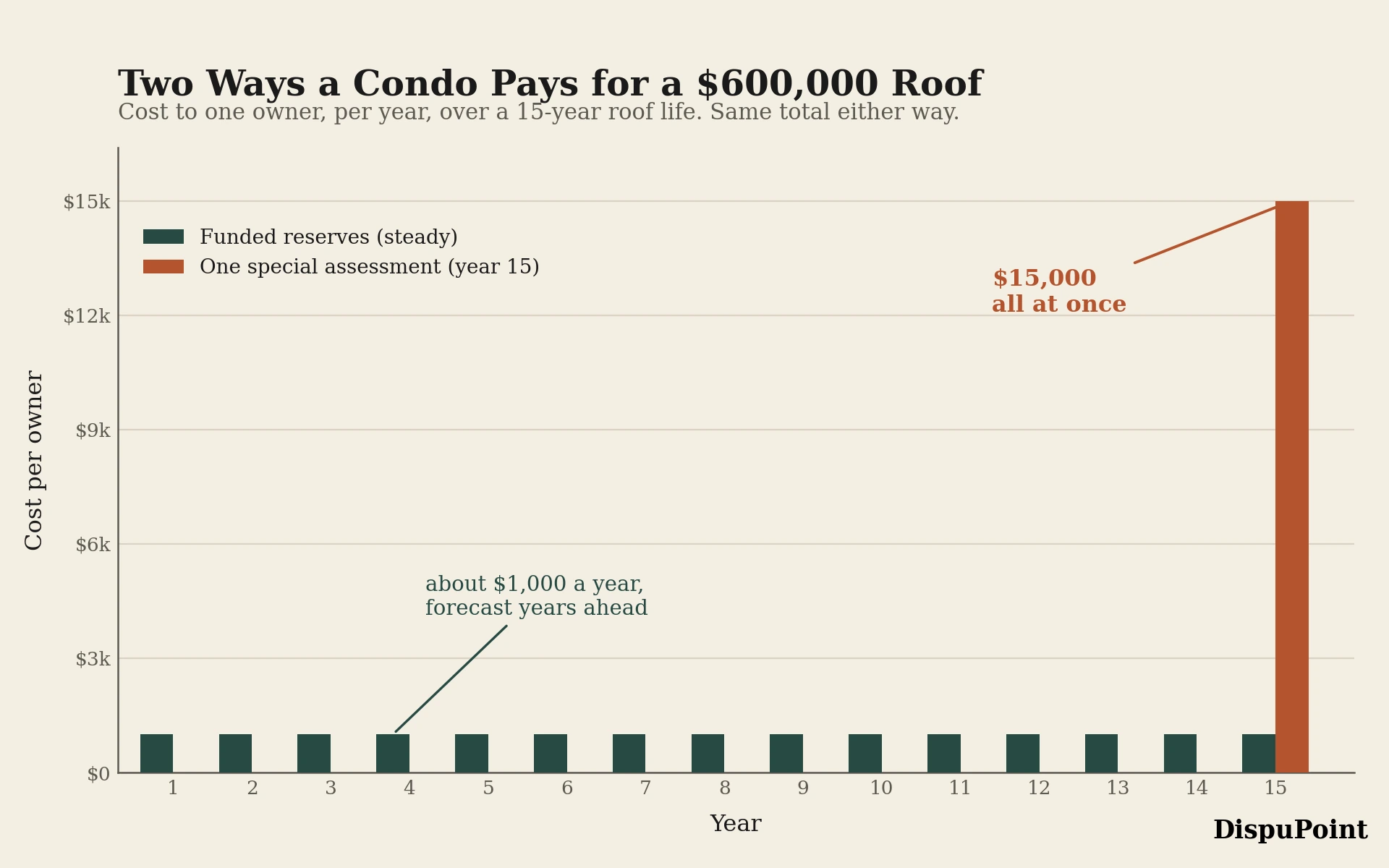
Now the part that separates a well-run building from a stressed one. Illinois requires condo boards to budget reasonable reserves for the big-ticket repairs and replacements, the roof, the elevators, the parking deck. A board that plans ahead sets money aside every year, so when the roof reaches the end of its life, the cash is already sitting there.
The special assessment you're staring at is often just the bill for years of that not happening. Same roof, same cost. One board forecasts it and nudges dues up a little each year. The other skips it and drops the whole thing on you at once.
What if you think the assessment is improper?
Don't go quiet, and don't just stop paying. In a condo, unpaid assessments become an automatic lien on your unit the moment you fall behind, and that lien can be foreclosed. In a non-condo HOA, there's no automatic lien unless your declaration created one, but silence still works against you.
The right move is to challenge the process, in writing. Ask for the meeting minutes, the notice the board sent, and the exact document language they're leaning on. A board that levied a big number without proper notice, or that ignored a valid petition, has to answer for it. If you want the wider picture on records and board accountability, we walk through it in who holds an Illinois HOA board accountable, and we cover the payment side in what happens if you stop paying HOA fees.
How to
Request the records behind a special assessment in writing
This letter puts the board on notice that you are reviewing their authority, not just paying the bill. Send it by certified mail and keep a copy.
[Date]

[Your Name]
[Your Unit Address]

[Board President or Property Manager Name]
[Association Name]
[Association Address]

Re: Records Request - Special Assessment Adopted [Date of Board Action]

Dear [Board President / Property Manager],

Pursuant to the Illinois Condominium Property Act or the Illinois Common Interest Community Association Act, as applicable, I am requesting copies of the following records related to the special assessment of $[Amount] adopted on [Date]:

1. The minutes of the board meeting at which this assessment was adopted.
2. The written notice sent to owners before that meeting, including the date it was sent.
3. The section of the current declaration and bylaws the board relied on to adopt this assessment.
4. Documentation of the prior fiscal year's total assessments and this year's total, and whether the 115 percent threshold was reached.

Please provide these records within the period required by law. I am available to review them in person or to receive copies by mail.

[Your Signature]
[Your Name]
[Phone / Email]
This builds a timestamped paper trail and forces the board to produce documents they may not have kept, or may not want you to see.
That letter is step one.
You can send the above letter, or we can handle the whole case ourselves, from start to finish.
Get my free assessmentNo payment now. The $349 only starts your case if you act.
FAQ
How long can a special assessment last in Illinois?
There's no statutory maximum. The board sets the schedule, a lump sum or installments over months or years, within the limits of your declaration and bylaws. Condo boards can run one across more than one fiscal year. Check the resolution that adopted it; the payment terms are spelled out there.
Can an Illinois condo or HOA board levy a special assessment without a vote?
Yes, up to a point. The board can adopt it on its own. But if the year's total assessments would exceed 115 percent of last year's, owners holding 20 percent of the votes can petition and force a meeting to reject it. Genuine emergencies skip that path.
Can the board put a lien on my home over an unpaid special assessment?
In a condo, yes, automatically, the moment you fall behind, and that lien can be foreclosed. In a non-condo HOA, only if your declaration grants that power, because CICAA creates no automatic lien. Either way, going silent is the worst move. Pay under protest and dispute it in writing.
What if the board didn't give proper notice?
Notice isn't optional. Owners are entitled to advance notice of the meeting where a special assessment is adopted. If the board skipped it, the assessment may be procedurally invalid. Request the notice they sent and the date it went out, then put any gap in writing to the board quickly.
Is a special assessment a sign my board is mismanaging money?
Not always. Emergencies and real surprises happen. But a large, out-of-nowhere assessment for a predictable repair like a roof can point to under-funded reserves. Illinois requires condo boards to budget reasonable reserves, so it's fair to ask why the money wasn't set aside.
How do I request HOA records to challenge a special assessment in Illinois?
This letter puts the board on notice that you are reviewing their authority, not just paying the bill. Send it by certified mail and keep a copy.