
You closed on the place. Somewhere in the pile is a declaration nobody read, a budget nobody explained, and a set of rules that shows up the first time you park wrong. So you sit down to read it all properly, and something in there feels off, but you can't name what.
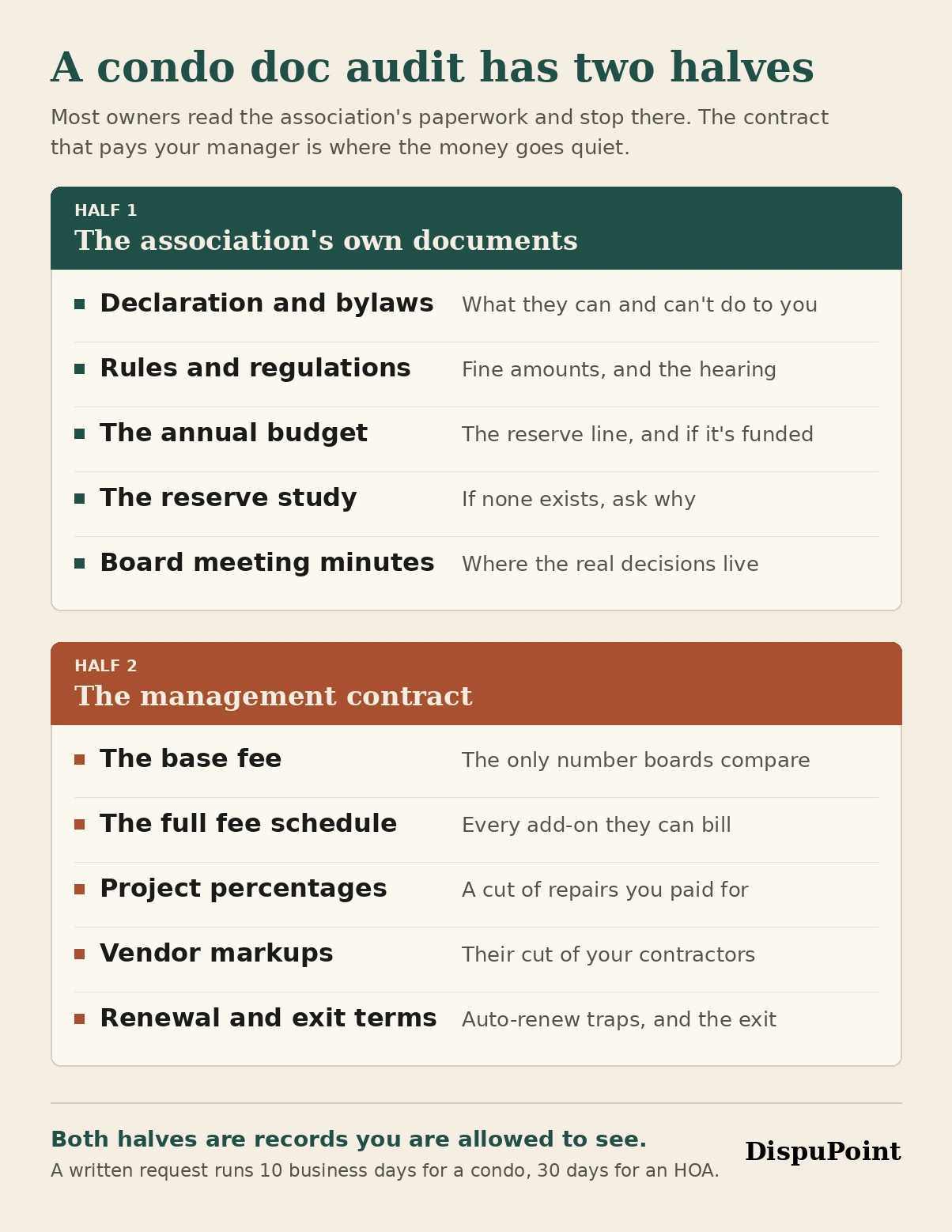
Here's the part almost everyone misses. Your condo docs are only half the picture. The other half is the contract between your association and the management company, and that's usually where the money goes quiet.
What you're actually entitled to hold
The stack is bigger than the closing packet. Under Illinois condo law, an owner can inspect the declaration and bylaws, the rules, the minutes, the insurance policies, the association's books for the current and past ten fiscal years, any reserve study, and every contract the association is a party to. That last one matters more than it sounds. The management agreement is a contract the association signed. It is a record. It is yours to read.
If you're not in a condo, the HOA statute gives you a similar list with a different clock. And if you're not sure which one you're in, that's a real question with a real answer, not a technicality.
Start with the reserve line, because it tells you the most
The budget is the most revealing thing in the stack, and the reserve line is the most revealing thing in the budget. A reserve fund is money set aside now for the roof, the elevator, the tuckpointing, the parking deck. It's the difference between a planned expense and a $9,000 letter that ruins your spring.
Illinois condo budgets aren't allowed to skip reserves. The law says the budget shall provide reasonable reserves for capital expenditures and deferred maintenance, and it tells the board what to weigh when setting the number: what the components cost to replace, how long they'll last, what any professional reserve study says, what an increase would do to owners, and whether the association could borrow instead. That's a real standard, not a suggestion. That reserve requirement comes straight from the Illinois Condominium Property Act.
So when a budget shows a reserve contribution that got waived, stop there. Waiving reserves takes a vote of two-thirds of all the votes in the association, and only where the condo instruments don't require reserves in the first place. A board cannot do it on its own at a Tuesday meeting. If your budget waived reserves, ask when the owner vote happened and ask for the minutes that record it. A waiver also has to be disclosed in the financial statements and in bold to anyone buying in. If nobody can point to the vote, you've found something real on page one.
Fine authority written vaguely enough to cover anything
Go to your rules and read how fines work. Illinois requires notice and a real chance to be heard before a fine sticks, in condos and in HOAs both. That's the floor, and plenty of boards clear it. The red flag is the language underneath.
Watch for a rule that reads like this: the board may impose fines for any conduct detrimental to the association.
Conduct detrimental to the association. What is that, exactly?
When the rule is that open-ended, the board gets to decide after the fact that whatever you did was covered. Your rules should name the violation, name the dollar amount or a range, and name the hearing process. If they don't, that isn't proof anyone will abuse it. It's proof they could, and it's the first thing to fix at the next amendment. We go through what a fine actually has to clear here.
Minutes that can't be produced
Boards have to keep minutes, and owners get to read them. Ask for the last twelve months. If the board can't produce them, one of two things is true, and neither is good: they weren't kept, or they don't want you reading them.
Minutes are where the explanation lives. The surprise assessment, the contractor nobody bid against, the rule that appeared without an announcement. All of it got decided in a room, and the record of that room is supposed to exist. Ask in writing. Keep your copy. Silence on a records request is its own piece of evidence, and we walk through how to use it here.
Who the board hired, and who they're related to
Illinois has a specific rule here and most owners have never heard it. Your board cannot sign a contract with a current board member, or with a company in which a board member or their immediate family holds a quarter or more, unless owners get notice within twenty days of the decision and a chance to petition for a vote on it.
So if the landscaping contract went to the treasurer's brother-in-law, the question isn't whether that feels wrong. The question is whether the notice went out and whether anyone told you that twenty percent of owners could have forced a vote. Nobody ever tells you. Look in the minutes for the decision date and see what happened in the twenty days after it.
The half almost nobody audits
Now the part I actually care about, and the reason your audit isn't done.
Your management company is not your enemy. It's closer to your employee, hired by the board, paid out of your assessments. A good one earns it. But it's a business with its own margin to protect, and the instrument that protects that margin is the contract your board signed, usually the standard form the company brought to the table.
That standard form is where fee leakage lives. The base fee is the number everyone compares. Then come the add-ons: a document fee when a unit sells, a transfer fee, a move-in fee, a charge per board meeting past the ones the base fee covers, a fee to mail a violation letter. Then the layer that never touches a statement at all: a percentage of every capital project, a markup on the contractor's invoice, a cut on payroll for on-site staff. Your board can run the entire roof job themselves and the company can still clip a percentage on the way through, because the contract said so and nobody read that line out loud. We did the math on exactly that here.
Illinois gives you two specific things to hunt with. First, the money has to stay separate: a company holding your reserves has to keep a separate account for your association and keep records identifying whose money is whose, and your association has to be the direct beneficiary of the bond covering the people who touch it. Second, and this is the sharp one, collection fees. A manager's fee for chasing a delinquent owner can only be added to that owner's share of the common expenses if the fee is a real collection cost, and it's written into the contract between the manager and the association, and your declaration or bylaws specifically say those fees can be added. All three. Miss one and it doesn't belong on the ledger.
You can't test any of that from your closing packet. You need the contract, the fee schedule, and the invoices. Then read your declaration next to them and see whether the authority the contract assumes actually exists. Your manager knows this document cold and you've never seen it, which is a gap worth closing. We wrote about that imbalance here.
Ask for both halves in one letter
One request, both halves, dated and specific. Vague asks get filed under later. Named documents start a clock. Send it where you can prove it arrived, keep your copy, and note the date you sent it.
How to
Request both halves of your association's file in writing
Send this to your board's official address, copying the management company. Use email with a read receipt or certified mail so you can prove the date. Keep a copy. A condo association that does not produce these records within 10 business days has denied the request under Illinois law, and an HOA has 30 days.
[Your Name]
[Your Unit Address]
[City, IL ZIP]
[Date]

Board of Directors
[Association Name]
c/o [Management Company Name]
[Address]

Re: Request to Inspect and Copy Association Records - Unit [Your Unit Number]

Dear Board Members,

I am an owner at [Association Name]. Under my right as a member to inspect and copy the records of the association, I request the following records. I am stating each with particularity as required.

Association records:

1. The current declaration, bylaws, and rules and regulations, including all amendments.
2. Minutes of all board meetings for the preceding 12 months.
3. The current adopted annual budget, with the reserve portion identified, and the itemized accounting of common expenses for the preceding fiscal year.
4. Any reserve study in the association's possession.
5. If reserve contributions have been waived in whole or in part, the minutes of the meeting at which the owners voted on that waiver.

Management and vendor records:

6. The current management agreement, including every exhibit, amendment, and fee schedule.
7. The complete schedule of additional or ancillary fees the management company is permitted to charge the association or individual owners.
8. Invoices from the management company to the association for the preceding 12 months.
9. Any agreement under which the management company receives a markup, commission, or referral payment from a vendor performing work for the association.

Please confirm receipt of this request and advise when and how I may inspect or receive copies of these records. I am willing to pay the actual costs of retrieval and copying permitted by law, and I request an itemized statement of those costs before they are incurred.

Sincerely,
[Your Name]
[Phone / Email]
This one letter closes the gap most owners never notice. It asks for the association's own documents and the contract that pays its manager in a single dated request, which means one clock, one paper trail, and no second round of asking. If part of it comes back and part of it doesn't, the part that didn't tells you where to look.
That letter is step one.
You can send the above letter, or we can handle the whole case ourselves, from start to finish.
Get my free assessmentNo payment now. The $349 only starts your case if you act.
FAQ
How do I get a copy of my condo association's management contract in Illinois?
Ask the board in writing. The management agreement is a contract the association is a party to, which makes it one of the records an owner can inspect and copy under Illinois condo law. Name it specifically, send it where you can prove the date, and keep your copy. A condo board that produces nothing within 10 business days has denied the request.
Is my Illinois condo association required to have a reserve fund?
Its budget is required to provide reasonable reserves for capital repairs and replacements, and the law lists the factors the board has to weigh in setting the amount. There's no fixed percentage. Reserves can only be waived by a vote of two-thirds of all association votes, and only where your condo instruments don't require them.
What is a reserve study and why does it matter?
It's a professional estimate of what your major common elements cost to replace and how much life they have left, which turns guessing into planning. Illinois doesn't force an association to commission one, but the law does tell boards to consider any study they have. If yours has never had one, the reserve number is somebody's guess.
Can my condo board hire a company owned by a board member?
Only with notice and an owner veto path. Illinois bars a board from contracting with a current board member, or a company in which a board member or their immediate family holds 25% or more, unless owners are notified within 20 days of the decision and can petition for a vote on it. No notice means the process failed, whatever the contract says.
Can a management company add its collection fees to my account?
Only if three things are all true: the fee is a genuine cost of collecting common expenses, it's written into the contract between the manager and the association, and your governing documents specifically authorize adding it to an owner's share. Missing any one of those, and the charge doesn't belong on your ledger. Make them show you all three.