You asked a question at the meeting. Or you sent one email around wondering out loud whether anybody else thought the board should be challenged on this.
Then nothing dramatic happened, which is the part everyone gets wrong about retaliation. It almost never shows up as a dramatic act. It shows up as your maintenance request sitting for a month when it used to come back in three days. It shows up as the community announcements that quietly stopped landing in your inbox. It shows up as a fine for the thing half the block does.
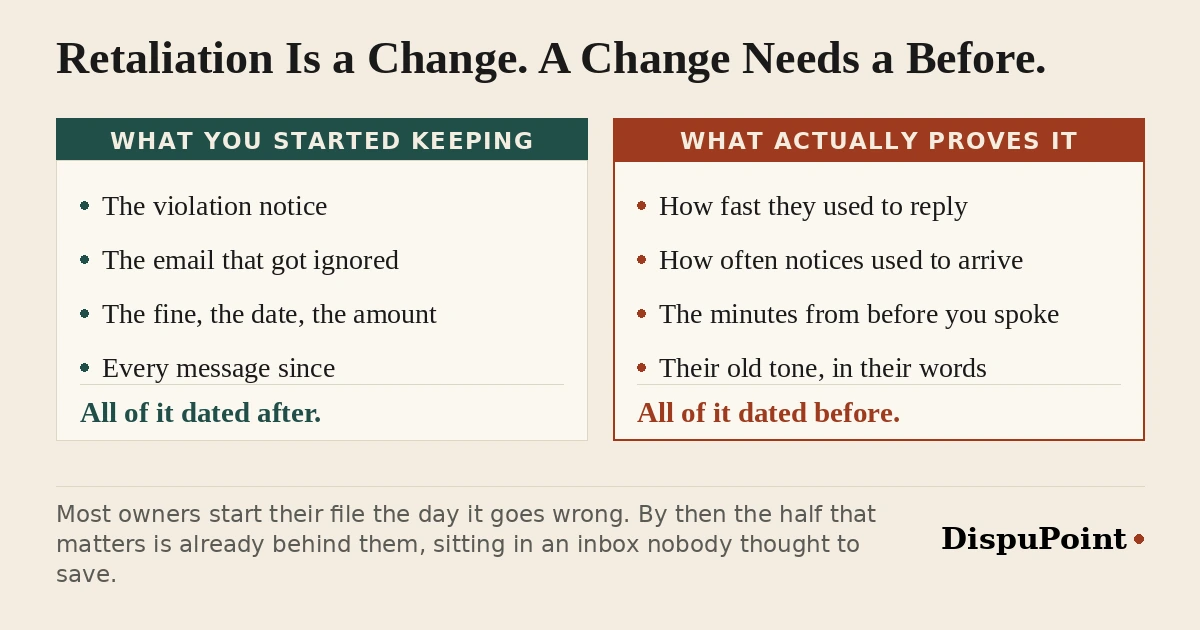
And when you finally sit down to make your case, you reach for the emails you started saving the day it went wrong. Here's the problem with those emails. They prove things are bad now. They can't prove anything changed.
Illinois Doesn't Have an HOA Retaliation Law
Let's clear this up first, because a lot of what's written about this online is simply wrong.
Illinois has a Landlord Retaliation Act. It protects tenants, and it has nothing to do with associations. CICAA, the state law that governs most Illinois HOAs, has no retaliation section in it at all. If you go hunting for the statute that says your board can't retaliate against you, you're going to come up empty, and anyone telling you otherwise hasn't read the act.
That sounds like bad news for about ten seconds. It isn't.
Retaliation isn't a thing you cite. It's a thing you demonstrate. You demonstrate it by showing the board started doing something differently the moment you became inconvenient. Not that they treated you badly. That they changed.
What Your Board Is Actually Betting On
Here's the cynical math, and it's worth naming out loud.
A board that's slow-walking you isn't losing sleep over a retaliation claim, because they know there isn't one. What they're counting on is that "they've been ignoring me since February" sounds like a feeling. Feelings don't move anybody. A dated pattern does, and they're betting you never built one.
They're usually right. Most owners start their file the day something goes wrong. By then the half that actually matters is already behind them, sitting in an inbox nobody thought to save.
The Four Rhythms Worth Writing Down
Tempo is the evidence, and four rhythms carry almost all of it. You already have every one of them.
Response time. How many days did a written request take to come back last year? Pick five from before and five from after, and put them in a column. You're not looking for slow. You're looking for slower than they used to be with you specifically.
Announcement cadence. Community notices, newsletters, the email about the parking lot resurfacing. Did those arrive monthly and then stop arriving to you while your neighbor still gets them? That's not a mood. That's a distribution list somebody edited.
Tone. Read an email from them in the good months, then read one from last week. Same person, same association. Nobody edits their own tone on purpose, which is exactly what makes it useful.
Enforcement cadence. When did they last cite anybody else for what they just cited you for? If the answer is "never, in six years," you're not looking at retaliation on its own. You're looking at retaliation sitting on top of selective enforcement, and the two reinforce each other.
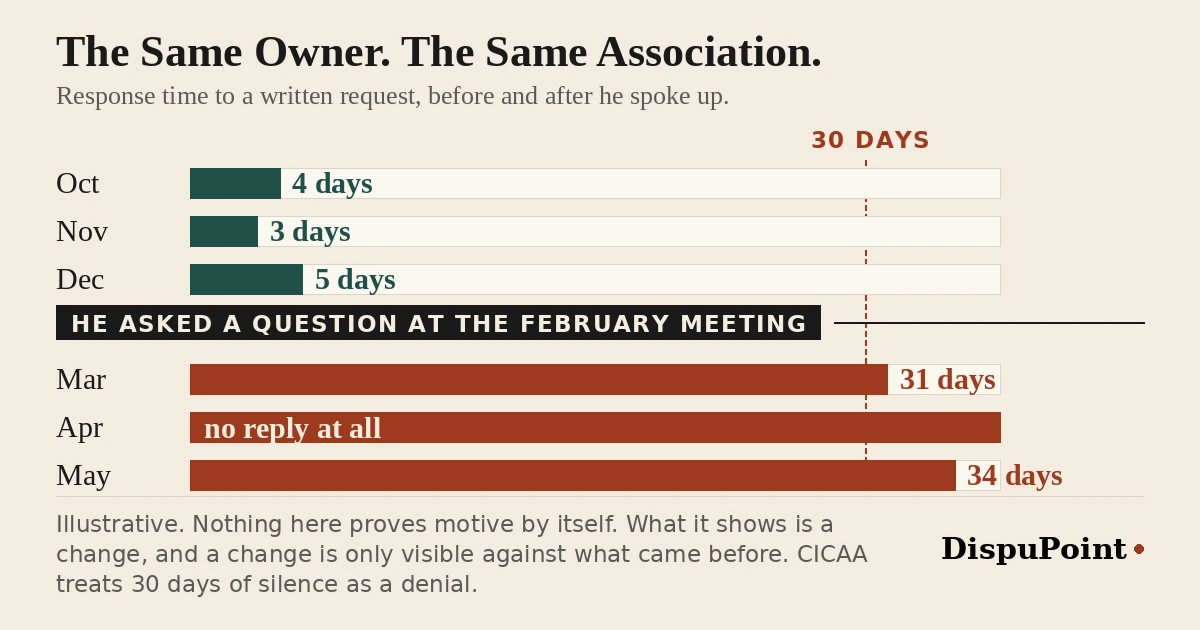
None of that proves motive by itself, and you shouldn't pretend it does. What it proves is that something changed on a specific date, and that the date is the same date you opened your mouth. Boards are remarkably bad at explaining that coincidence in writing.
The Thirty-Day Line You Can Actually Use
This is the part most owners never find.
Under CICAA, when you make a written records request to the board and thirty days go by with no records and no response, that silence isn't just rude. The law treats it as a denial. It's a bright line with a date on it, and it doesn't care why they stayed quiet.
Better than that. If you end up in court over those records and you win, and the court finds the failure came down to the board's own acts or omissions, you're entitled to your reasonable fees and costs. That's the statute putting its thumb on your side of the scale, which is rare enough in this corner of the law to be worth knowing.
Condo owners have a parallel records right under the Condominium Property Act. Different act, same idea.
So a records request does two jobs here at once. It gets you the baseline. And if they stonewall it, the stonewalling is itself a dated, documentable violation, sitting right next to the complaint that triggered it.
Where the Before Actually Lives
You don't need them to hand over their emails. You need the records they're already required to keep.
Board meeting minutes have to be kept for seven years. Seven. Those minutes show what got announced and when, how owner comments were handled, and what the board's rhythm looked like long before you were on their radar.
The itemized maintenance and repair records have to be kept too, along with the contracts the association signs. Those tell you what got fixed and how fast it happened. And the management contract is the sleeper: it often spells out the response times the company owes the association. If your manager is suddenly missing their own contractual clock with you and nobody else, that's not a vibe. That's a breach with your name on it, and we've written about what your management company actually charges for and owes.
Our guide to requesting HOA records in Illinois covers the mechanics. What's different here is what you're asking for. You're not asking about your dispute. You're asking for the pattern that existed before it.
How to
Request the records that establish your association's baseline
Send this by certified mail, return receipt requested, to the board and the management company on the same day. Keep the green card. The thirty-day clock starts when they receive it, not when you send it.
[Date]

[Your Name]
[Your Address]
[City, IL ZIP]

[Association Name]
Board of Directors
[Association Mailing Address]

Re: Written Request to Examine and Copy Association Records - Unit/Lot [Number]

Dear Board of Directors,

I am a member of record and I am making a written request to examine and copy the following association records. My purpose is to review the association's governance, communication, and maintenance history over the period stated below.

1. Minutes of all meetings of the board of directors from [date, 24 months back] through [today's date].

2. The detailed and itemized records of receipts and expenditures affecting the common areas for the same period, specifying the maintenance and repair expenses.

3. Copies of all contracts, leases, and other agreements entered into by the board that remain in effect, including the current management agreement.

4. Copies of the declaration, bylaws, and all rules and regulations currently in force, together with any amendments adopted during the period stated above.

Please confirm receipt of this request in writing and advise when and where the records will be made available for examination. I understand a reasonable fee may be charged for the cost of retrieving and copying records.

I would appreciate a response within 30 days of your receipt of this letter.

Sincerely,
[Your Name]
[Phone / Email]
You are asking only for records the association is already required by law to keep, which takes away the argument about whether you are entitled to them. If they respond, you get your baseline. If thirty days pass in silence, the law treats that as a denial, and the silence becomes its own dated violation.
That letter is step one.
You can send the above letter, or we can handle the whole case ourselves, from start to finish.
Get my free assessmentNo payment now. The $349 only starts your case if you act.
When the Timing Is the Whole Case
There's a line worth knowing here, and it's an Illinois case rather than a statute.
In Boucher v. 111 East Chestnut Condominium Association, a Chicago condo owner was fined $500 after criticizing the board and its manager. The appellate court held that a board can't fine an owner merely for criticizing it, that a recorded closed-session disciplinary hearing is part of the meeting's records the owner is entitled to see, and that a board owes a duty of candor before it penalizes somebody. The protection has real edges. Threats, fighting words, and false statements of fact aren't covered. Criticism is.
We've written about what that case hands you in the post on boards that fine owners for speaking up. The short version is that the money was never the point, and the board knew it.
The reason it matters here is the sequence. That fine didn't arrive out of nowhere. It arrived after. That's what turned it into a case instead of a complaint.
What We Do With This
If you send us your file, the baseline is the first thing we go looking for. Not the fine. Not the notice. The rhythm underneath both of them.
That's usually where the leverage is hiding, because it's the part nobody thinks to keep and the part the board never expects you to reconstruct. We pull the dates, line the before up against the after, name the rule the change actually broke, and put it in a letter that has to be answered rather than filed. You can see everything that's included in your file before you decide anything, and that first read is free.
We can't promise your board will explain themselves. We can make sure the question is on the record, with a date on it, in a form that's awkward to ignore.
Frequently asked questions
Is HOA retaliation illegal in Illinois?
There's no Illinois statute prohibiting HOA or condo association retaliation by name. The Landlord Retaliation Act covers tenants, not association members, and CICAA contains no retaliation section. What retaliation usually does is break a rule that is regulated, like records access, fine procedure, or consistent enforcement of the rules.
What counts as retaliation from an HOA board?
Retaliation is a change in how the board treats you after you exercise a right, ask a question, or push back. It usually looks unremarkable on its own: slower responses, announcements that stop arriving, a fine for something nobody else gets cited for. Each act looks defensible. The timing is what doesn't.
How do I prove my HOA retaliated against me?
By showing a change, which means you need a baseline. Pull how fast the board answered you before the incident, how often notices arrived, and when they last enforced that rule against anyone else. A dated pattern from before is worth more than a folder of angry emails from after.
Can my HOA fine me for speaking up at a board meeting?
Under Boucher v. 111 East Chestnut, an Illinois condo board can't fine an owner merely for criticizing the board or its manager. That protection doesn't reach threats, fighting words, or false statements of fact. Separately, a board has to give notice and an opportunity to be heard before it levies any fine at all.
How far back should I go when documenting my HOA's behavior?
Twenty-four months is a practical starting point and you can often go further. Illinois associations have to keep board meeting minutes for seven years, so the record exists whether or not you saved it. Request the minutes and the itemized maintenance records for the period before your dispute started.
Source: Boucher v. 111 East Chestnut Condominium Association, 2018 IL App (1st) 162233
FAQ
What records can I request to prove my HOA changed how it treats me?
Send this by certified mail, return receipt requested, to the board and the management company on the same day. Keep the green card. The thirty-day clock starts when they receive it, not when you send it.