You moved in, pulled back the carpet, and found a building falling apart beneath your feet. You pay your dues. You did everything right. And now you're lying awake wondering whether it gets worse tomorrow, while the HOA that's supposed to handle exactly this tells you they're still getting quotes. That gap between "we know" and "we've fixed it" is where this post lives, and by the end of it you'll know how to close it.
Who's Actually Responsible for Structural Damage in an Illinois Condo?
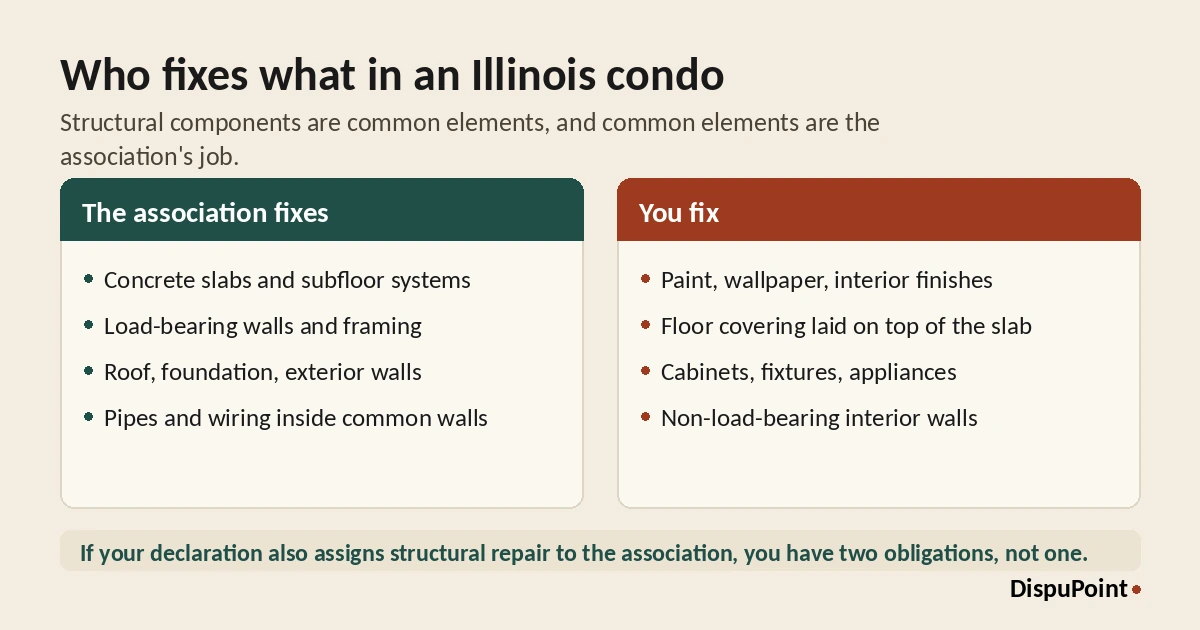
The short answer: the association. Under the Illinois Condominium Property Act, the board has a statutory duty to maintain, repair, and replace common elements. Separating concrete slabs in a six-story building are not your unit. They're the skeleton holding the building up. That makes them a common element, and that makes them the association's responsibility, full stop.
When your bylaws also say structural repairs belong to the association, you've got a contractual obligation stacked on top of a statutory one. The board doesn't get to debate whose problem it is. They already lost that argument when they drafted the governing documents.

What "We're Working on It" Actually Means, and When It Stops Being Acceptable
Two contractor visits over several weeks while you're paying $1,500 a month to sleep somewhere else is not a repair timeline. It's a shrug with paperwork attached.
Write out your timeline and look at what it actually says. Most of them look something like this:
- March 4: you report the floor. Property manager replies, says she'll get someone out.
- March 19: first contractor walks the unit. No report shared with you.
- April 2: second contractor. Same.
- April 14: you email asking for a start date. No reply.
- April 26: you email again. "We're still getting quotes."
Seven weeks. Two visits. Zero written scope, zero accepted bid, zero start date. Now put your rent receipts next to it. That's what the board's delay costs, in a form anyone can read in ten seconds.
So what exactly am I paying $400 a month in dues for?
That question is the real one, and it's not only about money. You bought into a building on the understanding that a system was in place for exactly this. Something breaks in the structure, everybody's dues pay to fix it, and you go on with your life. When that system stalls, you're not just out of pocket. You're living with a question nobody will answer: is this going to get worse?
The board isn't necessarily acting in bad faith. Sometimes they genuinely don't know how to manage a structural job. But their confusion is not your problem to absorb, financially or otherwise. At some point, "the HOA is still getting quotes" stops being a process and starts being a breach. Under Illinois contract law, when an association fails to fulfill its documented obligations while you're racking up costs, you've got the foundation of a breach of governing documents claim.
Can You Recover Your Temporary Housing Costs?
Possibly, yes. Illinois courts have recognized that when a party fails to fulfill a known legal duty and renders a space uninhabitable, the displaced person may be entitled to consequential damages, including alternative housing. It isn't automatic, and the amount matters, but the number is usually bigger than people think, because they only count the rent.
Add it up the way a judge would:
- Rental apartment: $1,500 a month
- Storage unit for the furniture that had to come out: $180 a month
- Extra gas and parking from the longer commute: $240 a month
- Assessments you kept paying on a unit you can't sleep in: $400 a month
That's $2,320 a month. Four months of "we're still getting quotes" is $9,280. Keep every receipt, and keep a one-page running total with dates. When you hand the board a number that has receipts behind it, the conversation changes.
Some of that is easier to recover than the rest. The gap between what you normally pay to live and what you're paying now is the strong part of the claim. Replacement furniture and upgrades are the weak part. Don't inflate it. A clean, conservative number you can document beats a big one you can't.
Before you assume you're on the hook for all of it, check two policies. Your own condo owner's policy may include loss-of-use coverage that kicks in when the unit is uninhabitable after a covered event. Ask your insurer three specific questions: is there a monthly cap, is there a total cap, and does the coverage apply when the cause is a common element failure. Then ask the board for the association's master policy certificate, because common-element damage may sit there instead. Neither one pays out on its own, but both are worth a phone call before you spend another month paying double housing.
There's a catch on that condo policy worth spelling out, and we owe this one to a reader. Cory Churchwell, a Chicago insurance agent with Farmers Insurance, pointed out something most owners miss: loss-of-use only pays when the damage traces back to a covered peril. In a case like this one, where the board sat on a known problem for years, your own carrier can deny the claim outright, which leaves the written demand to the association as your real path to the displacement money.
Get the Engineer's Report, Not Just the Repair
If you're worried about whether this happens again, the repair alone won't tell you. A patch closes the hole. It doesn't say what caused it or whether the same cause is sitting under three other units.
Ask the board in writing for the structural engineer's report, the contractor's written scope of work, and the accepted bid. If no engineer has looked at it, that is its own finding, and it belongs in your demand letter. A board that orders a floor repaired without knowing why the slab moved is guessing with your bedroom. You're entitled to ask them to stop guessing.
The Disclosure Problem You Might Not Have Thought About Yet
Here's the part that should bother you. If the building's lower floors have had the same problem, this wasn't new damage. Concrete slabs don't separate overnight. Someone, the seller or the association or both, may have known about a building-wide structural issue before you signed anything.
The Illinois Residential Real Property Disclosure Act requires sellers to disclose known material defects. So go looking for the paper. Request the board minutes for the three years before your closing and read them for words like slab, settlement, engineer, structural, or special assessment. If the minutes from two years before you bought show the board hired an engineer to look at the third floor, and nobody mentioned that to you at closing, that's a separate question worth asking, and it's a different fight from compelling the association to repair.
Why You Should Not Stop Paying Your Assessments
This is where good instincts get people hurt. In 2014 the Illinois Supreme Court decided a case called Spanish Court Two Condominium Association v. Carlson. A unit owner had water damage from a roof the association hadn't fixed, so she stopped paying her assessments. The association filed to take possession of her unit. The court held that the association's failure to repair was not a defense she could raise in that proceeding, and she still owed the money.
Read that again, because it's the whole lesson. The board being wrong about the repair does not make you right about withholding. It feels backwards to keep funding an association that's leaving you displaced. Do it anyway. Keep the dues current and pursue the repair and your costs as their own claim, so the board has nothing to point at but its own record.
How to Push the HOA Off the Slow-Walk
Verbal updates and a missed contractor appointment don't create legal pressure. Written demands do. The Condominium Property Act gives you the right to attend board meetings and raise unit-owner concerns formally. Use it. More importantly, put your demand in writing, name the bylaw section that assigns them responsibility, name the statute, set a deadline, and send it certified mail.
When you're documented and they're not, the record tells its own story.
How to
Send a written demand letter to your condo board for structural repairs
This letter creates a paper trail showing the board received formal notice of their legal obligation. Send it certified mail, return receipt requested, and keep a copy.
[Date]

To the Board of Directors,
[Association Name]
[Association Address]

Re: Formal Demand for Structural Repair - Unit [Your Unit Number]

I am writing to formally demand that the association complete structural repairs to my unit at [address] on an expedited basis.

As the board has acknowledged, the structural floor damage in my unit, separating concrete slabs confirmed during your inspection, is a common element repair under [cite your bylaw section, for example "Article X, Section X of the Declaration"]. This obligation is also established by the Illinois Condominium Property Act, which requires the association to maintain, repair, and replace common elements.

I have been displaced from my unit since [date] and am incurring alternative housing and related costs of $[amount] per month as a direct result of the association's failure to complete this repair. As of today those costs total $[running total]. Receipts are available on request.

For the record, the association's response to date consists of [for example: "two contractor site visits on [date] and [date], no written scope of work, and no repair start date"].

I am requesting the following, in writing, no later than [date 14 days from letter]:

1. A firm repair start date.
2. The contractor's written scope of work and the accepted bid.
3. Any structural engineer's report on the cause of the damage, or written confirmation that no such report exists.

If I do not receive that confirmation, I will consider all available remedies under Illinois law, including claims for breach of the governing documents and recovery of consequential damages.

Please direct your response to me at [your email and mailing address].

Sincerely,
[Your Name]
[Unit Number]
[Phone / Email]
A certified written demand creates the paper record that shifts the burden. It shows the board received formal notice, knew their obligation, and still delayed, which is what a breach of governing documents claim needs.
That letter is step one.
You can send the above letter, or we can handle the whole case ourselves, from start to finish.
Get my free assessmentNo payment now. The $349 only starts your case if you act.
FAQ
Is my condo HOA legally required to fix structural damage in Illinois?
Yes. The Illinois Condominium Property Act requires condo associations to maintain, repair, and replace common elements, which includes structural components like concrete slabs and subfloor systems. If your bylaws also assign structural repair to the association, that's a contractual obligation on top of the statutory one.
How do I formally demand my condo HOA make structural repairs in Illinois?
Put the demand in writing, reference the specific bylaw section and the Condominium Property Act by name, set a deadline, and send it certified mail. Verbal conversations don't create legal pressure. A written demand with a delivery receipt does.
Can I stop paying HOA dues if my unit is uninhabitable?
No. In Spanish Court Two Condominium Association v. Carlson, the Illinois Supreme Court ruled against an owner who withheld assessments over a roof the association failed to fix. Document your displacement costs and pursue them separately, and keep dues current so you're not handing the board a counterclaim.
How do I know the damage won't come back after the repair?
Ask for the structural engineer's report and the contractor's written scope before the work starts. If no engineer has assessed the cause, the board is repairing a symptom. Put that request in writing so the answer, either way, is part of the record.
Does my condo insurance cover temporary housing if my unit is uninhabitable?
It might. Many condo owner's policies include loss-of-use coverage when the unit is uninhabitable after a covered event. Call your insurer and ask whether there is a monthly cap, a total cap, and whether the coverage applies to a common element failure. The association's master policy may also be relevant.