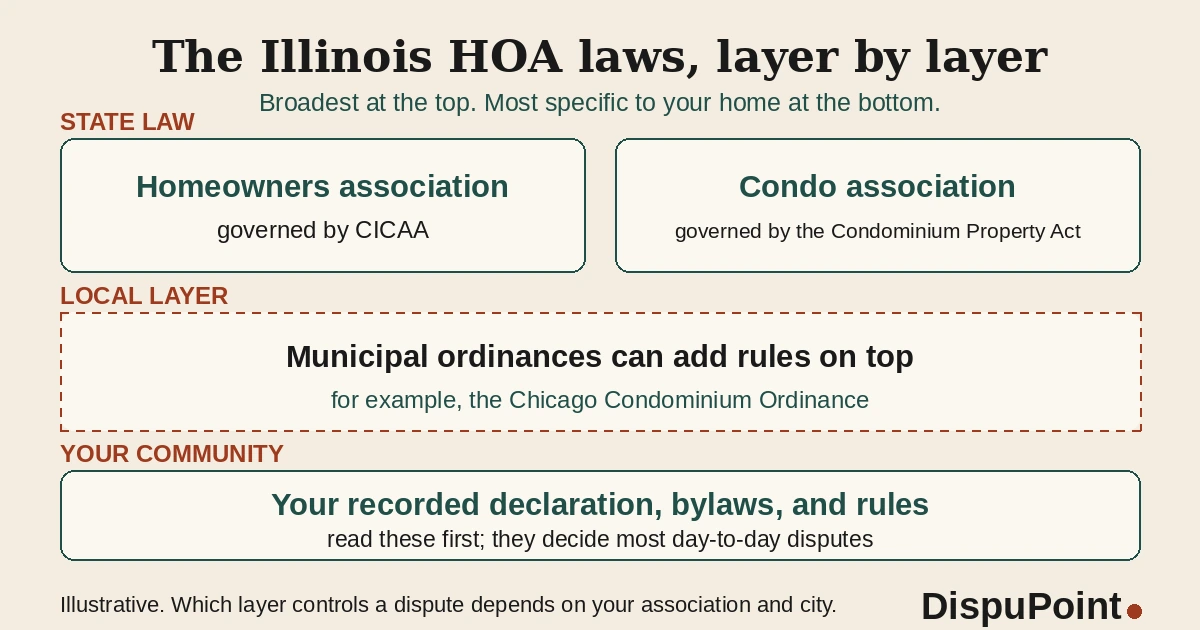
People search "Illinois HOA laws" expecting one rulebook. There isn't one. Illinois runs community associations under two separate statutes, and which one covers your community depends on what kind of association you live in. Cite the wrong one in your first letter and you hand the board a reason to dismiss you. Here is how to tell them apart.
Which law governs your community?
Illinois has two. The Common Interest Community Association Act, which most people shorten to CICAA, covers homeowners associations. The Illinois Condominium Property Act covers condominium buildings. They protect the same basic rights in different language, and they split on the specifics that decide real disputes. Your recorded declaration and your deed tell you which one you are under.
How the two laws differ
The quickest way to place yourself is what you own and where your rules live. A homeowner on their own lot answers mostly to their declaration, backed by CICAA. A condo owner shares walls, a roof, and a percentage of the building, and answers to the Condominium Property Act first.
- An HOA runs under CICAA. A condo runs under the Condominium Property Act.
- In an HOA you own your lot and home. In a condo you own your unit plus a share of the common elements.
- Either way, records come on a written request, most within 10 business days.
- An HOA leaves much of the assessment and lien detail to your declaration. A condo's Act spells it out, including how a board forecloses.
- Most HOA rules live in your declaration and bylaws. Most condo rules live in the Act first, then your declaration.
What homeowners actually fight about
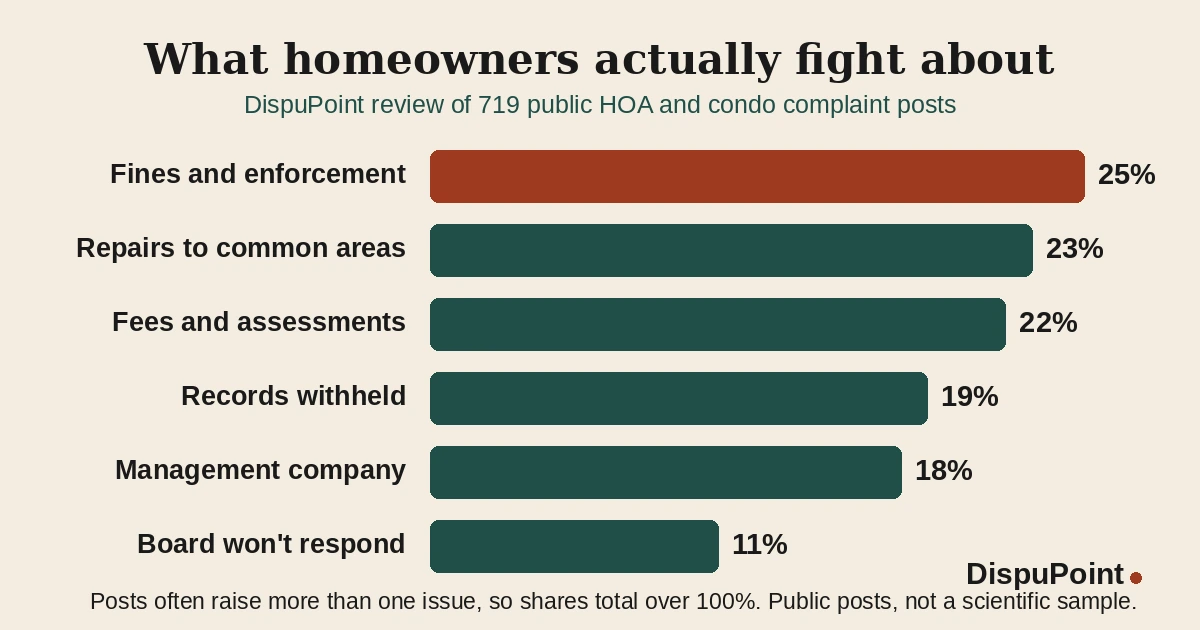
DispuPoint reviewed 719 public complaint posts from owners dealing with HOAs and condo associations. No single problem ran away with it. Fines and enforcement led at about one in four. Repairs to common areas, fees and assessments, and withheld records were all close behind.
The spread is the point. Because the problems are so varied, a generic "my HOA is unfair" letter rarely lands. The version that works names the right statute, the right right, and the specific thing the board failed to do.
The records deadline most boards get wrong
Since 2018, an Illinois association has to produce most records within ten business days of a proper written request. Before that, the window was thirty days. Plenty of boards, and even some managers, still quote the old number. Knowing the current one is often the difference between a request that gets answered and one that gets slow-walked. If you want the exact wording, here is how to request your HOA records in Illinois.
Do not forget your city's rules
The two state statutes are not the whole picture. Some Illinois municipalities layer their own ordinances on top. Chicago is the clearest example: its Condominium Ordinance sits in the city's municipal code and carries its own records-inspection rules for condo owners inside city limits. If you live in Chicago, you may have local protections a suburban owner does not, so it is worth checking your city's code alongside the state law before you send anything.
One rule that applies under both laws: keep paying
Even when your board is clearly in the wrong, withholding your assessments is usually the worst move you can make. In Spanish Court Two Condominium Association v. Carlson, the Illinois Supreme Court held that an owner who stopped paying assessments over an unrepaired roof could not raise the failed repair as a defense to the association's claim. The lesson holds across association types. Pay under protest, document everything, and fight on separate ground.
What neither law covers
Neither statute makes your board competent or fair. Neither sets a hard deadline for answering an ordinary complaint. That gap is where most owners get stuck. The board isn't breaking a clear rule, it is just doing nothing. The move there is to create a record the board has to answer, then press on the rights the statutes do give you.
What to do when your board ignores the law
Start by putting your request in writing and dating it. An unanswered written demand proves more than a dozen frustrated phone calls. Where you go next depends on the problem:
- If the board is withholding records, here is how to request them properly.
- If you are facing a fine you don't think holds up, start with how Illinois fines and enforcement actually work.
- If it is a special assessment or your dues, the money and assessments guides cover it.
- If the board simply won't answer, here is who holds an Illinois board accountable.
If the association is professionally managed, the manager's licensing regulator, the IDFPR, is another point of pressure worth knowing about.
Common questions
Is there one Illinois HOA law?
No. Illinois uses two statutes. CICAA covers homeowners associations and the Condominium Property Act covers condo buildings. They protect similar rights but differ on procedure, so the first step in any dispute is knowing which one governs your community.
How do I know if I'm in an HOA or a condo association?
Check your recorded declaration and your deed. A percentage of ownership in a shared building points to a condo association under the Condominium Property Act. A house or townhome on your own lot with association dues points to a common interest community under CICAA.
How long does my association have to give me records?
Since 2018, most Illinois associations have ten business days to produce records after a proper written request. The older thirty-day figure still circulates, so a board or manager may quote it. A written, dated request starts the clock and creates proof if they miss it.
Can my HOA fine me for anything it wants?
No. The board has to follow its own recorded rules and give you the process those rules require, usually notice and a chance to respond, before a fine sticks. A fine handed down without that process is often the weakest thing a board has done, and the easiest to challenge.
What if my board just ignores me?
That is the most common problem, and the law gives you room. Put every request in writing and date it. An unanswered written demand is strong evidence. From there you can escalate on records, meetings, or the manager's licensing, depending on what the board is neglecting.