I've watched this one play out a few times just in the last few months. Seasonal tenants moving in and out. An owner quietly turning a second unit into an investment property, or buying the tired place down the street to fix up and rent. And then, right on cue, the email lands: no more rentals. Effective immediately. Like flipping a switch.
Here is the part nobody tells you. The board sending an email is not the same as the board having the power. Those are two very different animals, and the gap between them is usually where you win.
Where the board's power actually comes from
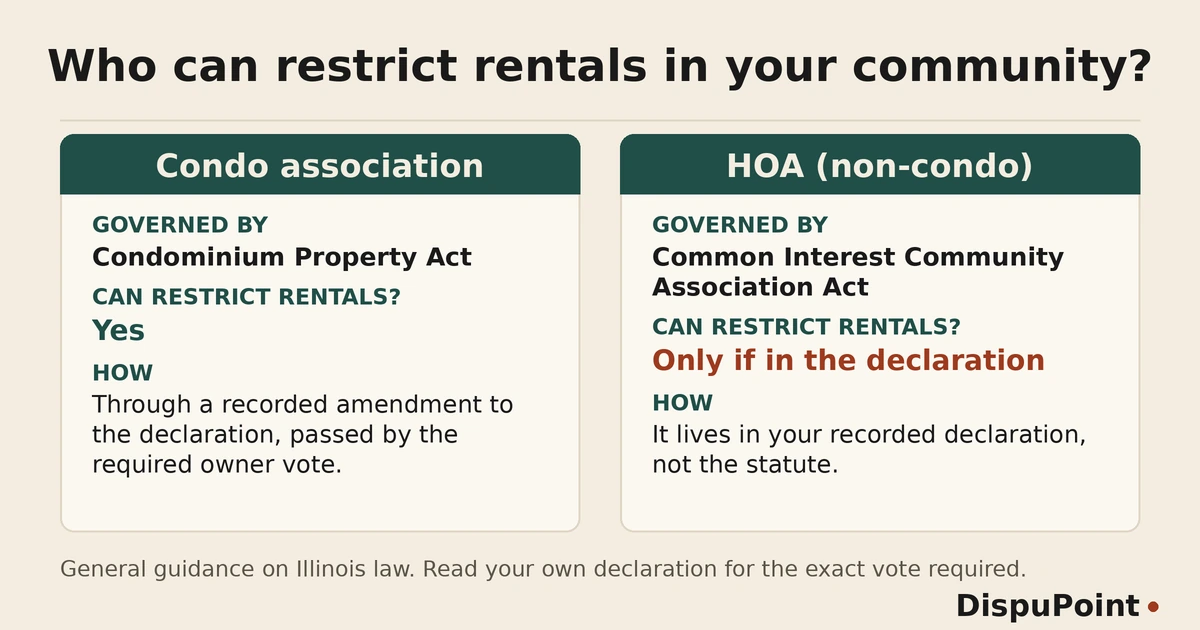
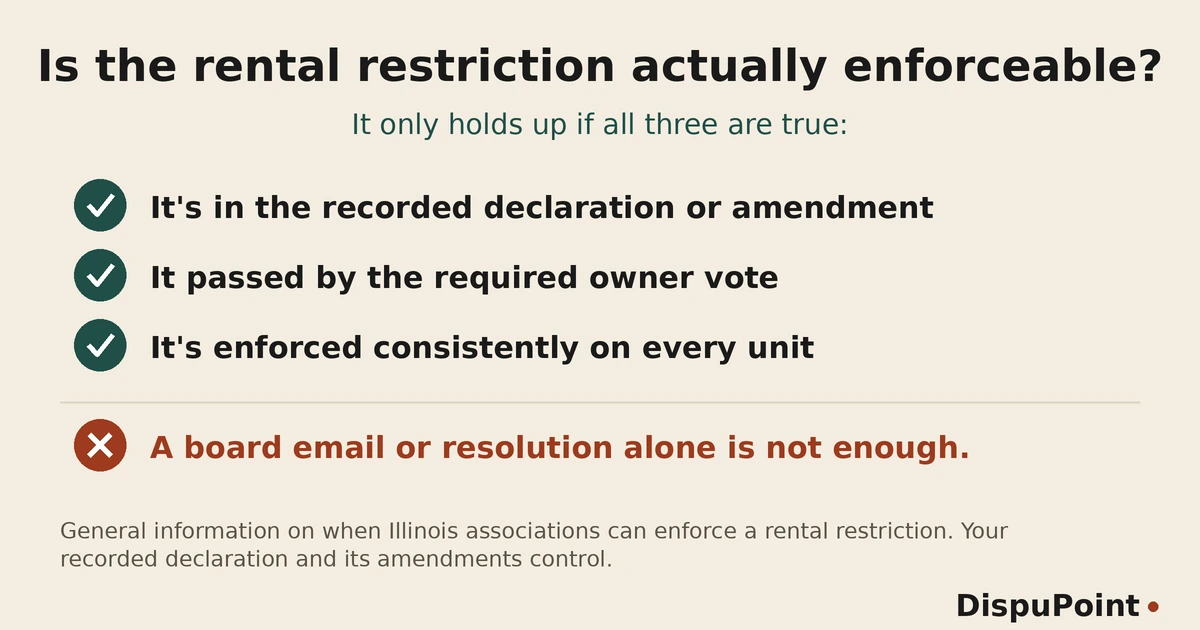
If you are in a condo association, the Illinois Condominium Property Act is the source. It lets an association restrict or even prohibit leasing, but only through a properly adopted amendment to the declaration, passed by the vote the declaration itself requires and then recorded with the county. A resolution passed at a board meeting is not that. It never was.
If you are in a non-condo HOA, you are under the Common Interest Community Association Act, and almost everything runs through your recorded declaration and covenants. CICAA does not hand the board independent leasing authority the way the Condominium Property Act does. If the restriction is not already in the recorded declaration, or added by a properly adopted and recorded amendment, it does not really exist yet.
"Properly adopted" is not a formality
The vote your board needed lives in your declaration, and it is almost always a supermajority. Commonly two-thirds or three-quarters of all owners, not just the handful who showed up. Some declarations add a wrinkle, like mortgagee approval for changes that touch how you can use your unit.
So if the board held a vote and came up short, or if they quietly changed the rules and regulations instead of amending the declaration, the restriction may not hold against you at all. Rules and regulations can govern a lot of day-to-day things. What they generally cannot do is invent a brand new limit on your property rights that the declaration never authorized.
Before you go any further, go get your declaration. Pull it and every amendment from the county recorder, or dig it out of your closing packet. Read the leasing and occupancy language yourself. What the board says the rule is and what the document actually says are, more often than you would think, two different stories.
Short-term rentals: same question, messier answer
Airbnb gets treated like its own beast, but the analysis starts in the same place: the declaration. Some declarations define leasing or occupancy broadly enough to swallow a stay of any length, which quietly pulls short-term rentals under the same restriction. Others say nothing about duration at all, and that silence is an opening.
Here is the trap boards walk into. Their favorite argument is that a weekend Airbnb is not a "lease" under the declaration, so it was never allowed. Fine. But if it is not a lease, then their lease-restriction authority does not reach it either, and they may need a separate, properly adopted provision to touch it at all. That ambiguity is not your problem. It is your leverage.
Grandfathering: when you might be exempt
Grandfathering is the piece everybody gets wrong. Some amendments come right out and say it: owners already renting when this passed can keep going, either for a set number of years or until they sell. When the language says that, it means it. Read it.
But even when the amendment says nothing about grandfathering, there is an argument under Illinois law that yanking away a use you already had, one you disclosed and leaned on financially when you bought, reaches further than an amendment is allowed to reach. That one is harder to win than plain grandfathering language, and it is not a sure thing. It is still a real theory, and a board hoping you have never heard of it is counting on your silence.
Selective enforcement is your real leverage
If the association is coming after you while three other units on your floor rent without a peep, that inconsistency can make the restriction unenforceable as applied to you, even when the restriction itself is valid. Illinois courts have treated selective enforcement of association rules as a genuine defense to fines and forced compliance.
So keep a record. Unit numbers if you have them, rough dates, how you know. You do not need a courtroom-ready dossier. You need enough to make the pattern impossible to wave away.
How to
Challenge a rental restriction in writing before you pay a dime
Send this when the association has fined you or told you to stop renting and you believe the restriction was never properly adopted, or is being enforced against you alone. Keep a copy. Send it certified mail.
[Date]

[Your Name]
[Unit Address]

[Association Name]
[Association Mailing Address]

Re: Dispute of Rental Restriction Enforcement - Unit [Number]

Dear [Board President or Property Manager Name],

I am writing to formally dispute the enforcement of the rental restriction at [Community Name] as applied to my unit.

Before I comply with or pay any fine related to this restriction, I am requesting the following in writing:

1. A copy of the recorded declaration amendment that authorizes this rental restriction, including the date it was recorded with [County] County.
2. Documentation of the owner vote that adopted the amendment, including the total number of units, the number voting in favor, and the vote threshold required by the declaration.
3. A copy of the current rules and regulations, if the restriction is claimed to come from a board resolution rather than the declaration.

If this restriction was adopted by board resolution rather than a properly recorded declaration amendment, I do not believe it is enforceable as a use restriction under Illinois law.

If this restriction is not being applied consistently across all units currently renting, I reserve the right to raise selective enforcement as a defense.

Please respond within 21 days. I am glad to discuss this once I have reviewed the documentation.

Sincerely,
[Your Name]
[Phone or Email]
This puts the association on record to produce the actual governing documents. If they cannot, they have just told you something important about whether this restriction was ever valid.
That letter is step one.
You can send the above letter, or we can handle the whole case ourselves, from start to finish.
Get my free assessmentNo payment now. The $349 only starts your case if you act.
The pattern I see, every time one of these goes sideways, is the same: the owner assumes the board has power it does not actually have, and the board is quietly counting on exactly that assumption. The authority to control what you do with your own unit is real. It comes from a recorded declaration and a proper vote, not from an email blast or a notice taped to the mailroom wall. Once you know the difference, you stop being the easy target.
FAQ
Can an HOA ban Airbnb rentals in Illinois?
Yes, if the ban is in the recorded declaration or added through a properly adopted and recorded amendment. A board policy or resolution usually is not enough on its own. If your declaration says nothing about rental duration, the association may need a declaration amendment before it can enforce a short-term rental ban against you.
Can an HOA force me to sell my unit if I rent it out?
In Illinois, an association can fine you and go to court for an injunction over a valid rental restriction, but forcing a sale is an extreme remedy courts rarely grant, and only after lesser steps. And if the restriction itself was never properly adopted, the whole enforcement action can fall apart first.
Does a rental restriction apply to me if I was already renting before it passed?
It depends on the amendment's language. Some explicitly protect owners who were already renting; others say nothing. If yours is silent, there is an argument that a retroactive restriction on an established use overreaches, though it is harder to win than plain grandfathering language.
What is the difference between HOA and condo rental rules in Illinois?
Condo associations draw their authority from the Illinois Condominium Property Act, which allows rental restrictions through a declaration amendment. Non-condo HOAs run under the Common Interest Community Association Act, which gives less independent power. There, the restriction has to live in the recorded declaration and covenants, not in the statute itself.
How do I challenge an HOA rental restriction in Illinois?
Send this when the association has fined you or told you to stop renting and you believe the restriction was never properly adopted, or is being enforced against you alone. Keep a copy. Send it certified mail.