Here is how it usually goes. You pay them every month. You don't ask questions, you mind your own business. Money goes out, the building runs, everybody leaves everybody alone. That is the arrangement.
Then the water heater dies. Ten years old, and you would rather swap it than nurse it through one more winter. You line up a plumber. Simple. Except your unit has no shut-off valve of its own, so the building has to cut the water for the job. Which means you need one thing from the people you pay every month: a date.
So you email and ask. They'll get back to you tomorrow. Tomorrow comes and goes. You email again. It's Friday, so fine, Monday. Monday, nothing. Tuesday, nothing. You call. No answer. You email the board and the property manager, and what comes back is an autoresponse, which is the corporate version of a shrug. The plumber calls to confirm and you ask him to hang tight. Another email, another call, the same autoresponse. By Friday he tells you the job is getting pushed to late next month.
Eventually you leave work early, sit in rush hour, drive to the management office, and stand in front of an actual person. Two days later you have your date. Forty-two days out. For a water heater.
That one is just annoying. Now change one detail. Instead of a water heater on your schedule, it is water coming down through your ceiling from the unit above. The drywall is going soft, there is a smell starting, and the damage keeps compounding by the day even after the leak itself gets stopped. You ask the association for the upstairs owner's contact information so you can shut off the source and figure out who pays, and you get the same silence, the same autoresponse, the same forty-two-day shrug. That is when a slow HOA stops being annoying and starts being expensive.
If you are an Illinois homeowner and any of that made your jaw tighten, here is what nobody tells you: the silence is not the end of your story. It is the start of your paper trail, and a paper trail is leverage.
Who Is Responsible for What?
Before you can push back, you need to know whether the repair is actually the HOA's job. Illinois homeowners associations are governed by the Common Interest Community Association Act (CICAA), 765 ILCS 160. Your declaration - the legal document that created your association - spells out which areas the association maintains and which ones you own outright.
Common area infrastructure like roofs, parking lots, shared plumbing, and exterior walls typically fall on the association. Interior unit repairs usually fall on you. If you are not sure where the line is, the declaration is the controlling document, not what a board member told you at a meeting.
Does Illinois Law Require the HOA to Respond?
CICAA does not set a hard statutory deadline for responding to every maintenance request. What it does require is that associations follow their own governing documents. If your declaration or rules promise a response window - say, 30 days for non-emergency repairs - the association is bound to that.
And what exactly am I paying you for?
Beyond the governing documents, associations have a general duty to maintain common elements and keep them in good repair. A board that ignores a legitimate maintenance issue for months is not just being difficult - it may be breaching that duty, which matters if the problem causes damage or a safety hazard.
Why a Paper Trail Changes Everything
A verbal complaint disappears. A written request does not. The moment you put your maintenance request in writing and send it to the board or management company in a way you can document - certified mail, email with a delivery receipt, the association's official portal - you create a record.
That record becomes evidence if you later need to escalate to the board, file a complaint, or pursue a formal dispute. It also puts the association on notice in a way that matters legally. Boards that ignore documented requests face a much harder time arguing they were unaware of a problem.
How to Escalate When Silence Continues
If a written request gets no response, your next steps depend on how serious the situation is.
For non-emergency issues, send a follow-up letter to the full board (not just the property manager) referencing your original request and asking for a written timeline. Boards tend to respond differently when they know you are tracking dates.
For safety issues - water intrusion, structural damage, mold, anything that affects habitability - consider contacting your local building department. A municipal code inspector operates independently of your HOA and can issue citations the board cannot ignore.
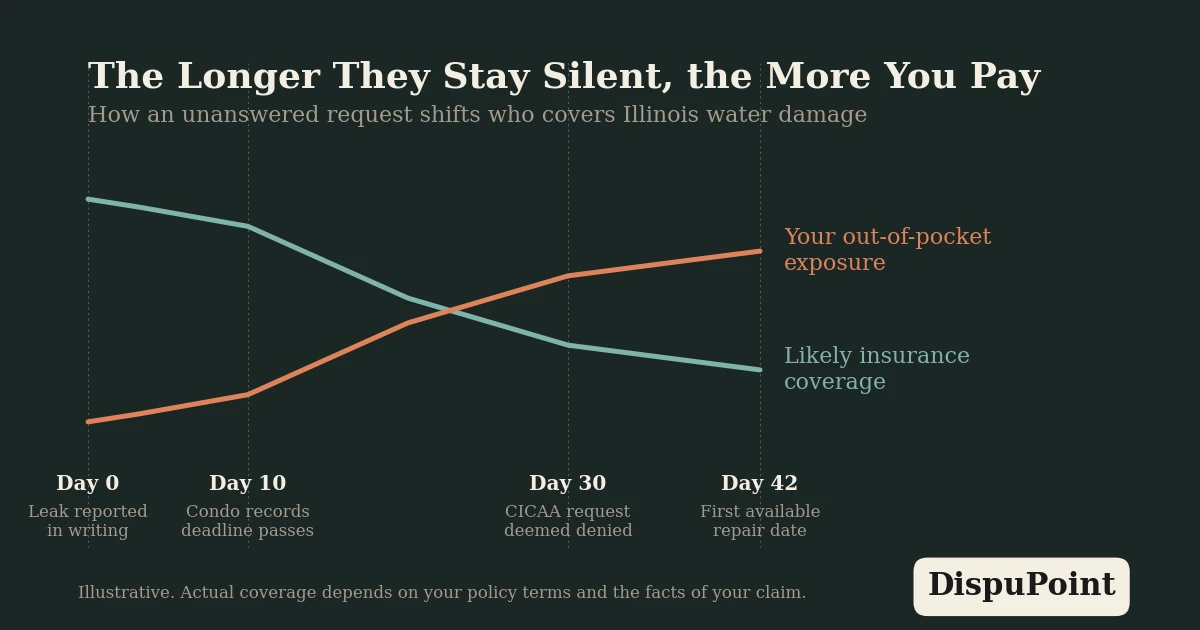
If the association's silence is costing you money, document every loss with photos, receipts, and a written log. This is where it gets serious: water coming down from the unit above, a leaking roof that ruins your belongings, mold spreading behind the drywall. Water damage compounds even after the leak is stopped, so every day the board sits on your request, the repair bill grows. If the association is also refusing to give you the upstairs owner's contact information so you can stop the source and sort out who pays, document that refusal too. It becomes part of the same paper trail. That documentation supports a formal dispute or a small claims action later.
Requesting Records to Understand the Pattern
If your maintenance issue has been ignored, you may not be the only one. Under CICAA (765 ILCS 160/1-30), you have the right to inspect association records, including board meeting minutes and financial records, with proper written notice. Meeting minutes sometimes show that your request was received and discussed - which is useful information if the board later claims they never knew about it.
Condo owners have a parallel right under the Illinois Condominium Property Act (765 ILCS 605/19). The timelines differ slightly between the two statutes.
Seeing a pattern of deferred maintenance across multiple units can also strengthen a case that the board is not meeting its obligations to the community as a whole - not just to you.
How to
Send a written maintenance follow-up to your HOA board
Use this letter when your original request has gone unanswered. Send it by certified mail or email with a delivery receipt, and keep a copy. This creates the documented record that matters most if you need to escalate.
[Your Name]
[Your Address]
[City, IL ZIP]
[Date]

Board of Directors
[Association Name]
[Association Address]

Re: Follow-Up Maintenance Request - [Brief Description of Issue]

Dear Board Members,

On [original request date], I submitted a maintenance request regarding [describe the problem and its location, e.g., "a water leak at the roof above Unit 12B"]. As of today, I have not received a response or a repair timeline.

Under our governing documents and applicable Illinois law, the association is responsible for maintaining [common element or shared infrastructure at issue]. This issue has not been addressed and [describe any ongoing harm, e.g., "continues to cause water intrusion into my unit"].

I am requesting a written response confirming receipt of this notice and a specific timeline for repair within [14 or 30] days.

If I do not receive a response by [specific date], I will consider my further options, which may include filing a complaint with the appropriate authority or pursuing a formal dispute.

Thank you for your prompt attention.

Sincerely,
[Your Name]
[Phone or email]
Written notice with a deadline puts the board on record and gives you a documented timeline if you need to escalate to mediation, arbitration, or court.
That letter is step one.
You can send the above letter, or we can handle the whole case ourselves, from start to finish.
Get my free assessmentNo payment now. The $349 only starts your case if you act.
When the Delay Becomes the Damage
Here is the part most homeowners miss. When water sits, it does not just sit. Drywall wicks it, mold sets in, and a lot of insurance policies cap or flat-out exclude mold. So a leak that should have been a clean claim turns into a partial payout, and the gap comes out of your pocket. The cause of that gap is often the delay itself, the weeks the board spent not answering you.
That changes the question of who pays. If you can show the association sat on a documented request while the damage compounded, the extra loss may not be yours to eat. Working out who is actually responsible for water damage between units comes first, and pulling the records that prove the timeline is what turns your story into a documented one. This is where a paper trail stops being a record and starts being a case.
If it comes to that, escalation runs on a ladder. A formal demand puts the board on notice and is usually meant to get you an answer without going further. If that does not land, a documented dossier is what backs you up if you decide to take it to small claims or hand it to an attorney. The demand is the goal. The dossier is what makes the demand mean something.
FAQ
What should I do if my HOA ignores my written maintenance request?
Send a follow-up letter to the full board by certified mail, reference your original request date, and set a written deadline for a response. If silence continues, consider contacting your local building department for safety issues or reviewing your governing documents for a formal dispute process.
Can an Illinois HOA be forced to make repairs?
Yes. Associations have a legal duty under their governing documents to maintain common elements. If they fail to do so and that failure causes damage, homeowners may have grounds to pursue a formal dispute, request mediation, or file in small claims court for out-of-pocket losses.
Does Illinois law set a deadline for HOA maintenance responses?
CICAA does not set a universal response deadline for maintenance requests. The governing document - your declaration or rules - controls. If those documents promise a timeline, the association is bound to it. If they are silent, the general duty of maintenance and care still applies.
How do I get HOA meeting minutes to check if my request was discussed?
Submit a written records inspection request to the association under 765 ILCS 160/1-30 (for HOAs) or 765 ILCS 605/19 (for condos). The association has 30 days (HOA) or 10 business days (condo) to respond after receiving your request.
What if the unaddressed maintenance issue is damaging my property?
Document everything immediately - photos with timestamps, written logs of each incident, and receipts for any out-of-pocket costs. This documentation supports a damages claim later. For ongoing or worsening situations, contact your local building or housing authority in addition to the board.