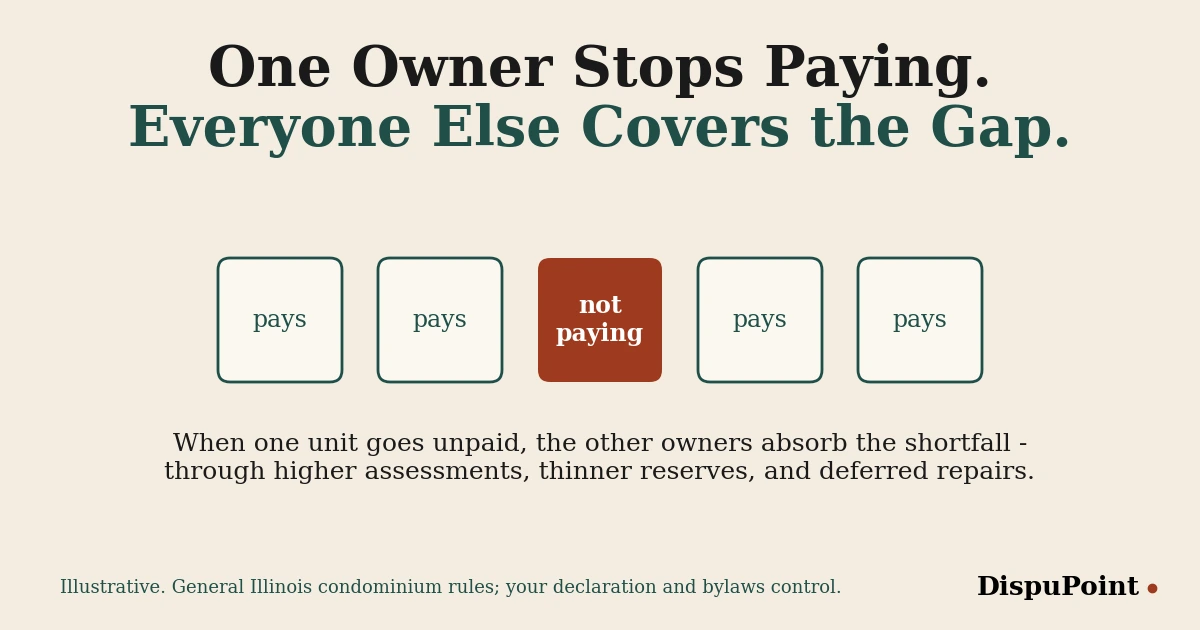
One owner stops paying. A year goes by. The board sends a letter, nothing happens, and meanwhile every other owner is quietly subsidizing the shortfall. If you're the one asking why nothing is being done, you're asking the right question - and Illinois law has a sharper answer than your board might want to hear.
What Illinois Law Actually Says About Unpaid Assessments
Under the Illinois Condominium Property Act, every unit owner is legally obligated to pay assessments. That's not a suggestion buried in the bylaws - it's a statutory duty. When an owner stops paying, a lien attaches to the unit automatically by operation of law. No vote, no court filing, no separate recording required for the lien to exist.
One thing to settle first, because it changes everything: this is condo law. If you're actually in a non-condo HOA, there is no automatic lien at all, and what your board can do comes down to your declaration. We cover that case on its own in our post on whether an Illinois HOA can take your paid-off home. Everything below assumes a condominium.
Recording the lien is still worth doing, though, and I'll get to that.
The Lien Is Already There - So Why Isn't Anything Happening?
This is the part that frustrates me every time I see it. The board already has a loaded tool in its hand. The Condominium Property Act expressly authorizes two separate collection paths once assessments go unpaid.
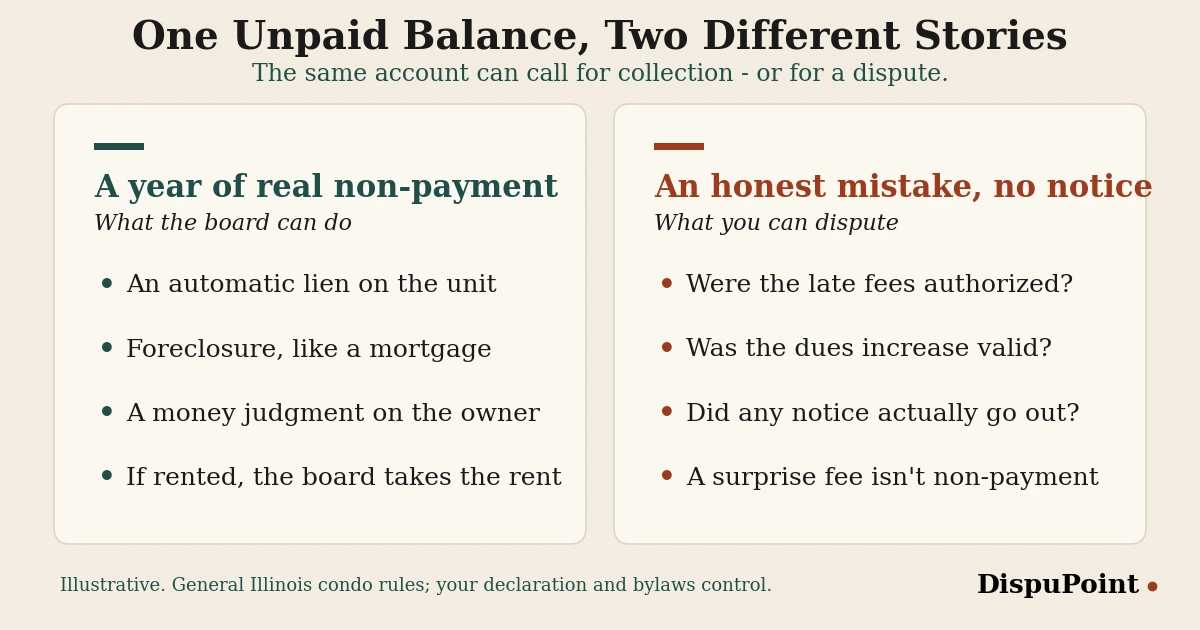
The first is lien foreclosure. The association can foreclose the assessment lien the same way a lender forecloses a mortgage, using the Illinois Mortgage Foreclosure Law. That process can end with the unit being sold to satisfy the debt. The second is a money judgment. The association can go to court and get a judgment against the owner personally without touching the lien at all - useful if the owner has other assets or if foreclosure feels like too much firepower for now.
Both options are live. The board doesn't have to pick one and abandon the other.
Why Recording the Lien Still Matters
The lien attaches automatically, but priority is a different story. If the owner has a mortgage or other creditors, your unrecorded lien may end up behind them in line. Recording the lien with the county recorder gives the association a timestamp that can determine who gets paid first when the unit eventually sells or refinances.
For a unit that's been delinquent over a year, recording is not optional housekeeping - it's financial protection for every other owner in the building.
If the Unit Is Rented, There's a Third Move
Here's one a lot of boards overlook. If the delinquent owner is renting the unit out, the board doesn't have to wait on a foreclosure to see a dollar. It can bring an eviction action, and this is where Illinois condo law does something people don't expect.
The board isn't trying to take the home. An assessment eviction is temporary, and the owner keeps title the entire way through. What the board gets is possession, and once it has that, Illinois law hands the tenant's rent to the association until the unpaid balance is cleared. The rent that used to go to the owner now goes to the people the owner stopped paying. The Illinois Supreme Court laid this out in Knolls Condominium Association v. Harms: possession is a temporary remedy that ends once the debt is paid, and title never leaves the owner.
One wrinkle worth knowing. The board can record a lien without warning the owner first, but it has to give notice before it files an eviction. So if a rented unit is deep in the hole and nothing is moving, a fair question for the board is whether that notice has actually gone out yet.
Before You Write Off the Neighbor: Not Every Delinquency Is a Deadbeat
Here's the part that complicates the tidy version of this story. When an owner goes a full year paying nothing, a lien is a reasonable response, even when it feels harsh. That owner is shifting their share onto everyone else, and the board has a duty to do something about it.
But a lot of these cases aren't that. They're mistakes. An autopay set up years ago that never adjusted when assessments went up. A dues increase of a few percent that quietly outran the amount somebody had on file, so a small shortfall stacked up month after month with nobody flagging it. A single late payment that snowballed into two late charges before the owner ever saw a notice.
If that second story is the one you recognize, the legal question flips. You're not asking how to collect. You're asking whether the charges piling up against you are even valid.
And Illinois gives you real ground to stand on. Were the late charges actually authorized by your declaration or rules, because a board can't invent a fee its own documents don't allow. Was the assessment increase adopted the way the statute and your bylaws require, at a properly noticed meeting. Did the board follow its own notice process before the charges started stacking. Sort those out and a "delinquency" can start to look a lot more like a billing dispute the board should never have let harden.
The Board's Reluctance Is Understandable - But It Has a Cost
I get why boards hesitate. Foreclosure sounds extreme. Nobody wants to be the neighbor who took someone's home. But here's what that reluctance actually means in practice: the remaining owners are covering the shortfall, whether through higher special assessments, deferred maintenance, or reserves that shrink a little every month.
Under Illinois law, board members owe a fiduciary duty to the association. That duty runs to all the owners who are paying, not just the one who isn't. A board that sits on a delinquency this long without taking action isn't playing it safe - it's making a decision that costs every other owner money, and that decision has legal exposure attached to it.
What the Board Should Do Right Now
The demand letter was a start. It's not enough. Here's the sequence that actually moves the needle:
Record the lien with the county recorder if you haven't already. Then consult a collections attorney about whether to pursue foreclosure, a money judgment, or an eviction - the right path depends on how much is owed, whether the unit carries a mortgage, and whether it's occupied by the owner or a tenant. Either way, doing nothing for another six months is not a neutral act.
How to
Formally demand the board take collection action in writing
If you're an owner (not a board member) and the board won't move, putting your demand in writing creates a record and signals you're serious. Use this as a starting point.
[Date]

To the Board of Directors,
[Association Name]
[Association Address]

I am writing as the owner of Unit [Unit Number] to formally request that the board take enforcement action on the delinquent assessment account for Unit [Delinquent Unit Number].

To my knowledge, this unit has not paid assessments for approximately [time period]. Illinois law under the Condominium Property Act grants the association the right to foreclose the assessment lien, seek a money judgment against the owner, or, if the unit is leased, bring an eviction action and apply the tenant's rent to the balance.

The board's fiduciary duty runs to all paying owners. Continued inaction shifts financial burden to owners who are current on their obligations. I am asking that the board, at its next meeting, place collection enforcement on the agenda and report back to owners on the steps it intends to take and the timeline for taking them.

Please confirm receipt of this letter and provide a written response within [14 or 30] days.

Sincerely,
[Your Name]
[Your Unit Number]
[Your Contact Information]
A written demand creates a paper trail that the board has been put on notice, which matters if you later need to raise a fiduciary duty argument.
That letter is step one.
You can send the above letter, or we can handle the whole case ourselves, from start to finish.
Get my free assessmentNo payment now. The $349 only starts your case if you act.
---
FAQ
How do I force my condo board to collect unpaid dues in Illinois?
Put your demand in writing, reference the board's fiduciary duty under Illinois law, and request that collection enforcement be placed on the next meeting agenda. If the board still doesn't act, you can consult a community association attorney about owner-initiated remedies. A written record of your demand matters if the situation escalates.
I got hit with late fees on a shortfall I didn't know about. Can I fight them?
Often, yes. A late charge only sticks if your declaration or rules actually authorize it, and boards are supposed to follow their own notice steps before charges pile up. If an autopay missed a dues increase and the fees stacked with no warning, that's a billing dispute, not willful non-payment. Object in writing and ask for the full account history.
Does an Illinois condo association have to go to court to collect unpaid assessments?
Not necessarily for a money judgment, but yes for foreclosure - that requires a court proceeding under the Illinois Mortgage Foreclosure Law. The association can also pursue a money judgment through civil court without foreclosing the lien. The right path depends on the amount owed and the owner's financial situation.
Does a condo lien in Illinois need to be recorded to be valid?
No. Under the Illinois Condominium Property Act, the lien attaches automatically when assessments go unpaid - no recording required for it to exist. But recording with the county recorder matters for priority against other creditors, and it's strongly advisable once a delinquency becomes serious.
Can a condo association take a tenant's rent to cover the owner's unpaid dues?
Yes, in Illinois. If the delinquent unit is rented out, the association can bring an eviction action, and once it wins possession, the tenant's rent is applied to the unpaid assessments. The owner keeps title. It's a targeted remedy that doesn't require full foreclosure proceedings.
How long can a condo owner go without paying dues before the association acts?
There's no statutory deadline that forces the board's hand, but delay has real costs - to reserves, to other owners, and potentially to the board members themselves through fiduciary duty exposure. Once a delinquency passes a year, the case for action is hard to argue against. At minimum, the lien should be recorded and an attorney consulted.