A surprise special assessment lands in your mailbox, and the number is ugly. The board says the reserve fund ran dry, so now you owe. Before you write that check, there is something the board is counting on you not to know. It changed everything for one owner we worked with.
Whose problem is a common-element leak, anyway?
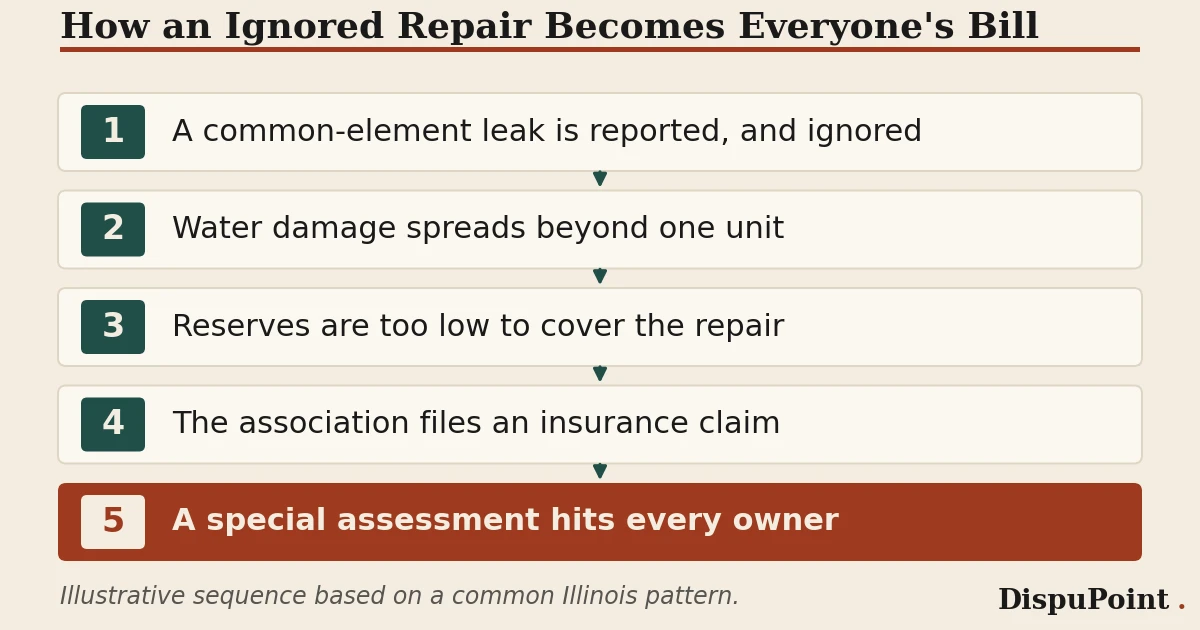
We worked with an owner of a ground-floor unit that had flooded more than once over the years. The water was not coming from anything he did. It traced back to a common element, the shared parts of the building the association is responsible for. He reported it. Nothing happened.
Here is why nothing happened: the reserve fund was too low to pay for the fix, so the board sat on it. What they missed is that a leak from a common element was never only his problem. Left alone, it was going to become the whole building's problem. It did.
The damage eventually got bad enough that the association had to file an insurance claim to cover the repair. Then the cost came back around to every owner. The premium jumped after the claim, and the board raised assessments to cover both the higher premium and to rebuild the reserve it should have funded all along.
So a repair the board could not afford turned into a permanent cost for everyone. Where did the reserve money go in the first place? That is the question the records answer.
What Illinois law actually requires here
Illinois condo boards do not get to shrug off a common element. The Condominium Property Act puts the duty to maintain, repair, and replace the common elements on the board, not on the owner standing in the water. That same Act tells the board to adopt an annual budget that provides for reasonable reserves, based on how old the building is and what its big-ticket parts cost to replace. Skipping that for years is not just sloppy. It is operating outside the law.
The Act also requires the association to carry property insurance on the common elements. That is why the claim in our owner's building was even possible. And it sets the rules for how a special assessment gets adopted, including when owners can petition for a vote. There is a catch buried in those rules, and we will come back to it, because it is the reason this particular assessment was hard to stop.
If your community is a townhome or a non-condo HOA, a sibling law, the Common Interest Community Association Act, carries most of the same duties. Illinois also gives condo and community-association owners a state complaint path through the Ombudsperson program, once you have used your association's own written complaint procedure.
So the law is on your side about who owns the problem. The leverage is proving what the board actually did, and that lives in the records.
Your right to see the budget and the reserve study
Here is the part the board may not advertise: you can inspect the association's books and records, including the current and prior-year budgets and any reserve study on file. You send a written request, and the board has to make them available.
A reserve study lays out the lifespan and replacement cost of the big components, the roof, boilers, elevators, parking. It says what the fund should hold to cover them. If there is no study, or the study existed and got ignored, that alone tells you how the money was managed. And once you have the numbers, one figure tells you almost everything.
Is your reserve fund actually healthy? One number tells you
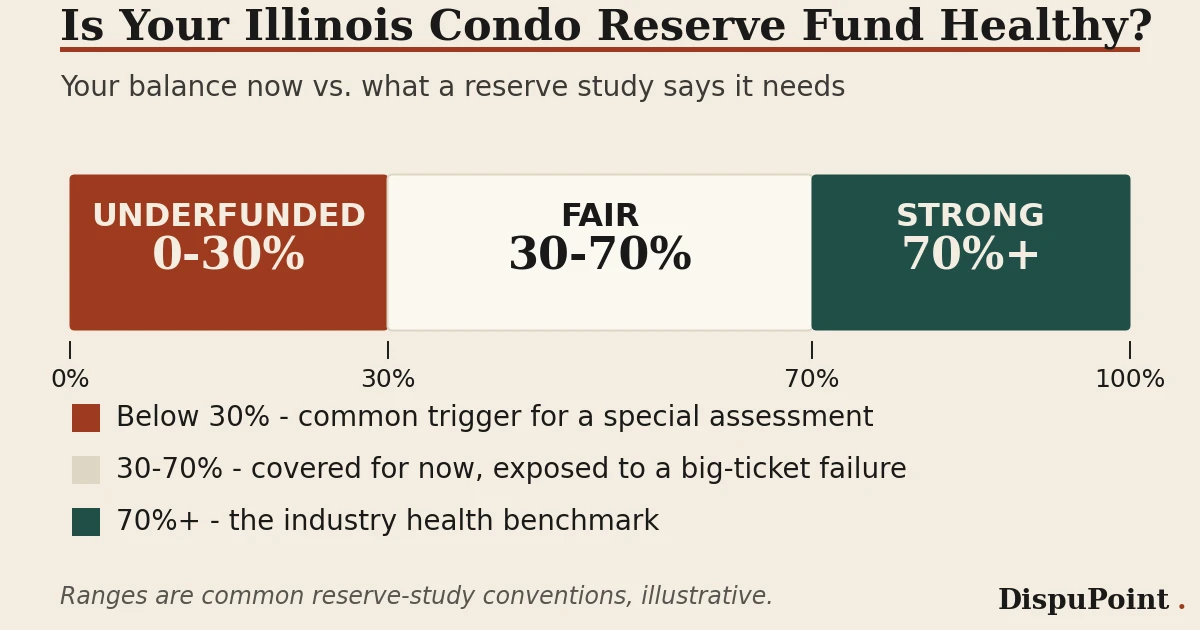
The figure to find is percent funded: what the reserve holds now against what the study says it needs. A fund sitting below 30 percent funded, on a study that is even a couple of years old, is a real problem. It means owners before you paid in, and that money got spent or never set aside.
{{CHART_B}}
How to turn the financials into leverage
If the records show reserve contributions were skipped, cut, or moved elsewhere, that is not just annoying. It is the basis for a formal objection before you pay. You can dispute the assessment at an owner meeting, vote against a budget that does not fix the underlying gap, and put every objection in writing so there is a record. Owners who organize around this can force a board to defend its funding decisions out loud.
But there is a line you should not cross, and it is the mistake most angry owners make first.
What not to do (the move that backfires)
Do not just stop paying. Unpaid assessments become liens under Illinois law, and lien enforcement moves faster than most owners expect. The smarter play is to pay under written protest while you pursue the underlying dispute, so you are not handing the board an easy foreclosure angle while you fight the real issue.
Be fair about the diagnosis too. Not every thin reserve is misconduct. Some boards inherited a mess, and the study was never done right. The records are what let you tell an honest mistake from a pattern. And that catch in the special-assessment rules? Here it is: emergency repairs, and anything the law requires, are usually carved out of the owner petition right. An emergency claim like the one our owner's building faced is exactly the kind a board can assess for without a vote. Knowing that changes how you fight it, and when.
How to
Request your condo association's financial records and reserve study in writing
This letter puts your request on the record and starts the clock. Under the Condominium Property Act, the board must respond. Keep a copy and note the date you sent it.
[Your Name]
[Unit Address]
[City, IL ZIP]
[Date]

Board of Directors
[Association Name]
[Association Address]

Re: Written Request for Financial Records and Reserve Study

Dear Board Members,

Pursuant to my rights under the Illinois Condominium Property Act, I am requesting the opportunity to inspect and receive copies of the following records:

1. The current fiscal year adopted budget, including the reserve fund line item and any reserve contribution schedule.
2. The two most recently adopted annual budgets.
3. Any reserve study or reserve fund analysis on file, including the most recent update.
4. Reserve fund account statements for the past 24 months.
5. Any board minutes or resolutions discussing reserve fund contributions or special assessments.

Please contact me within a reasonable time to arrange inspection or to advise me of the copy cost. I am happy to review these at the management office.

Sincerely,
[Your Name]
[Phone or Email]
A written request creates a paper trail and puts the board on notice that you are paying attention. Boards that know you have the records tend to be more careful about what they say next.
That letter is step one.
You can send the above letter, or we can handle the whole case ourselves, from start to finish.
Get my free assessmentNo payment now. The $349 only starts your case if you act.
FAQ
How do I request reserve fund records from my Illinois condo association?
Send a written request to the board or management company citing the Illinois Condominium Property Act. Ask specifically for the reserve study, the current and prior-year budgets, and the reserve fund account statements. The board is required to make these available to unit owners. Keep a copy of your request and note the date you sent it.
The board won't fix a common element because reserves are low. Is that allowed?
No. The Illinois Condominium Property Act puts the duty to maintain, repair, and replace common elements on the board, and a thin reserve does not erase that duty. Low reserves are the board's funding failure, not a defense. If damage spreads because a repair was delayed, that history strengthens your position.
Can a condo board in Illinois issue a special assessment without owner approval?
Sometimes. The Act lets owners petition for a vote when a separate assessment rises above a set share of the annual budget. But emergency repairs, and anything the law requires, are usually carved out of that petition right. Check your declaration for the specific limit that applies to your association.
What can I do if I think my board mismanaged the reserve fund?
Start by getting the financial records. Compare what the reserve holds to what the reserve study says it should hold. If contributions were skipped or reduced over multiple budget cycles, put your objections in writing, raise them at an owner meeting, and organize other owners. Pay any assessment under written protest, because unpaid amounts can become liens quickly.
Does paying a special assessment mean I give up my right to challenge it?
No. You can pay under protest and still pursue a formal objection. Note on your check or in an accompanying letter that payment is made under protest while you dispute the assessment's basis. This protects you from lien enforcement while keeping your position on the record. Consult a real estate attorney if you are weighing a formal legal challenge.