I'm the guy on the other side of your complaint. I sit on a condo board, in the room where your problem actually gets decided. And I'm going to tell you something most homeowners never find out: by the time your case reaches us, it has already been edited.
Not shredded. Not faked. Edited. Trimmed down to the version that makes the people doing the trimming look fine. I've watched it happen more times than I can count, and once you see how it works, you never send a complaint the same way again.
Who actually decides your HOA complaint?
Your association runs on two sets of hands. There's the board, a few owners who got elected and now make the calls. And there's the property management company, the vendor the board pays to run the place day to day. Homeowners conflate the two constantly. They are not the same thing.
When it comes to your dispute, the board almost always gets the last word. The manager doesn't decide. The manager decides what the board hears before the board votes. That is a very different job, and it is the whole ballgame.
Why won't the property manager give the board the full story?
Picture a kid who comes home after getting in trouble at school. You ask what happened. Do you get the unabridged version, both sides, every detail that makes them look bad? Of course not. You get their cut of it.
Not because the kid is lying. Because nobody on earth volunteers the parts that make them look bad. Now hand that kid a salary and a contract to protect. That's your property manager.
The board hires them, pays them, renews them. So imagine that manager has to walk into a room and tell the people who sign the checks that something slipped. That they rubber-stamped a process that broke the rules. That the mistake, this time, was theirs. You think that account comes out balanced?
Does that make the property manager a villain?
No. It makes them human. Nobody wants to be the one carrying bad news up the stairs. Nobody wants to look careless or green in front of the people who decide whether they keep the contract.
I'd love to tell you the system is rigged by bad actors. It's worse than that. It's rigged by ordinary people doing the very ordinary thing of protecting themselves. You'd do it too.
What does a one-sided briefing actually look like?
I've watched it from the inside. An issue comes up. The manager lays out a quick version, their version, and then pivots fast: "So, board, how do you want to handle this? We can send it to collections, we can hand it to a lawyer, or we can let it sit." And just like that, the manager is off the hook. The decision, and the blame that rides with it, has been handed to us.
I learned to stop the room. Hold on. Did we get all the emails from this person? Did we see everything they sent, or just the parts that made it into the summary? The answer, gently delivered, was always some version of the same thing: "This is what happened. I'll forward you whatever I have." And that was that. Hands washed. Problem now ours, on a partial record.
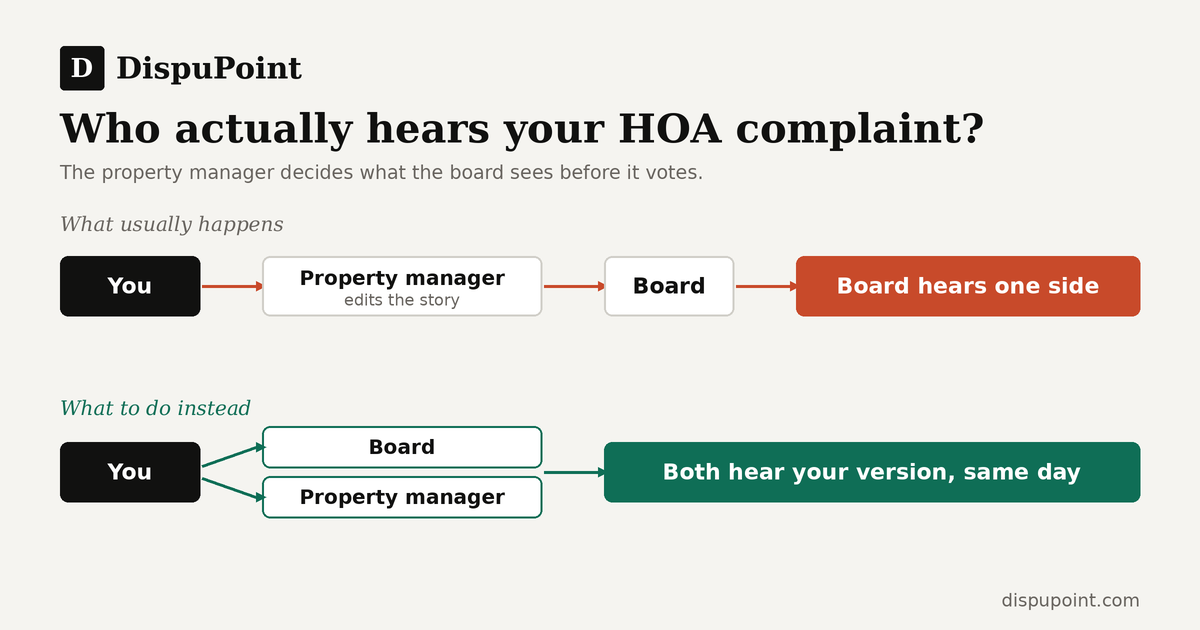
Send it to both at once and the manager loses the one thing they had: control of the narrative.
So how do you make sure the board hears your actual case?
You stop trusting the relay. You send your complaint to everyone with a hand in the decision, at the same time. The board and the management company, same letter, same day.
Not because you're picking a fight. Because you're refusing to let one person with a stake in the outcome be the only narrator. That's it. That's the entire trick. It costs you nothing and it changes who's holding the pen.
One management company billed fees its own staffer admitted were not in the rules, in writing, on the day it charged them.
How do you send it the right way?
Keep it plain. You don't need legal language. You need a clear statement of the issue, addressed to both parties, on the same date, with proof it landed.
How to
Send your complaint to the board and the manager together.
Address it to both. Same letter, same date. Email is fine, just ask for confirmation of receipt.
To:   [HOA / Condo Board of Directors]
Cc:   [Property Management Company]
Date: [today's date]
Re:   [the issue, in one line]

I am writing to formally raise the following issue: [describe it plainly].
I am sending this to the board and to management at the same time, so
both have the same information on the same date.

Please confirm receipt. I would appreciate a written response by [date].
Why this works: the board now has your side directly, not the trimmed-down version from the one person who might be at fault.
That letter is step one.
You can send the above letter, or we can handle the whole case ourselves, from start to finish.
Get my free assessmentNo payment now. The $349 only starts your case if you act.
Why does it have to be in writing to all of them?
Because writing is the one thing the manager can't quietly edit. When the board and the manager are both holding the same dated letter, your version doesn't get summarized down to nothing in a closed meeting. It sits in the record, in full, with a date on it.
An unanswered request to everyone who could have fixed it is a far louder document than a complaint that died quietly in one person's inbox. That paper trail is leverage. It's the thing that gives your next move, a follow-up demand or a complaint to a regulator, something solid to stand on.
This is the whole reason every case we work ships with two letters, one for the board and one for the management company, built to go out together. Small move. It also happens to be the one most homeowners skip, right up until the day they realize the board never actually heard them.
FAQ
Should I send my HOA complaint to the board or the property manager?
Both. Same letter, same day. The manager runs daily operations, but the board usually has the final say on disputes. Send it to the manager alone and the board may only ever hear a summarized, one-sided version of your case.
Does the property manager actually tell the board about my complaint?
Sometimes, and rarely in full. The manager decides what the board hears and how it's framed. If your complaint touches something the manager got wrong, expect the account that reaches the board to be thin. Copy the board directly and remove the guesswork.
Will copying the board make me look difficult?
No. Sending one letter to the board and the manager on the same date is normal. You're not attacking anyone. You're making sure the people who decide your case received the same facts at the same time, with nothing lost on the way up.
How do I find out who is on my HOA or condo board?
Your governing documents, annual meeting notices, and your state's records-request process will name the current directors. Most associations have to disclose that to owners on request. If management drags its feet, that stall is worth documenting in writing too.
What if the board still backs the property manager?
You're better off than before. You now hold a dated record showing the decision-makers saw your full case, not a summary, and chose their answer anyway. That record is exactly what gives a follow-up demand or a regulator complaint its teeth.