
When your condo board or management company stops answering, it feels like you paid into a system that has decided to ignore you. And what exactly are my dues paying for? That frustration is valid - and Illinois law gives you more leverage than most owners realize. Here is how to use it.
What Does Illinois Law Actually Require Your Board to Do?
Under the Illinois Condominium Property Act (765 ILCS 605/18.4), your board has an affirmative legal duty to enforce the declaration and bylaws. This is not optional. The board cannot simply choose to look the other way at violations - including violations by the management company it hired. Ignoring complaints about those violations can rise to the level of a breach of fiduciary duty.
Does It Matter Whether You Have a Condo or an HOA?
It does. Condominiums in Illinois fall under the Illinois Condominium Property Act (765 ILCS 605). Homeowners associations in planned communities fall under the Common Interest Community Association Act, or CICAA (765 ILCS 160). Both impose enforcement duties on boards, but the specific procedures differ. If you own a unit in a building with shared walls and a common lobby, you are almost certainly under 765 ILCS 605. When in doubt, check your declaration - it will name the governing statute.
Why a Phone Call Is Not Enough
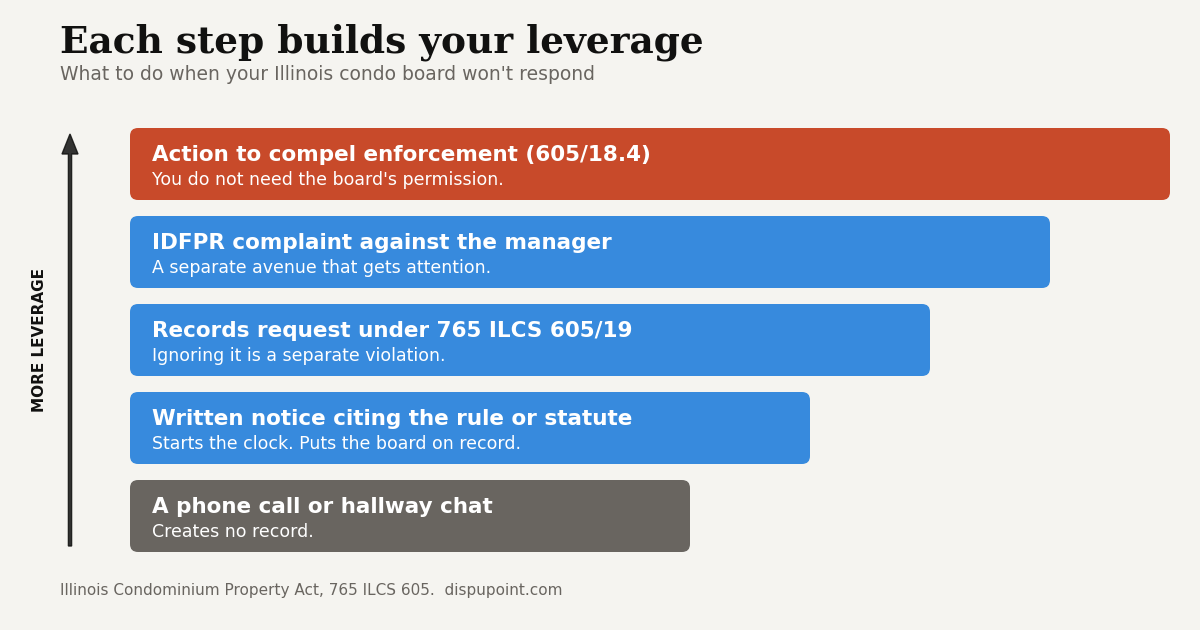
If you have only called or stopped someone in the hallway, you have not created a record. Illinois courts and regulators look for written notice. A written complaint tied to a specific rule or statutory provision puts the board or management company on formal notice. From that point on, continued silence or inaction is documented - and that documentation is what gives you options.
A year of ignored emails ended nine days after one anchored letter.
What Rights Do You Have to See the Records?
Under 765 ILCS 605/19, unit owners have a statutory right to inspect the association's books and records. If you suspect a management company is billing improperly or that the board is not following its own budget rules, a written records request is often the right first move. Failure to respond to a proper request is itself a statutory violation - separate from whatever underlying problem prompted your complaint.
What About the Management Company Specifically?
Property managers in Illinois are licensed through the Illinois Department of Financial and Professional Regulation (IDFPR) under the Illinois Real Estate License Act (225 ILCS 454). If a licensed manager is engaging in deceptive billing, ignoring written complaints, or otherwise acting outside their authority, you can file a complaint with IDFPR. This is a separate avenue from anything you pursue against the board - and it can get attention from a management company that has stopped caring what owners think.
What Happens If You Have Already Sent a Written Complaint and Nothing Changed?
That is where the leverage actually is. Unit owners under 765 ILCS 605 can bring a legal action to compel the board to enforce the declaration and bylaws. You do not need the board's permission to do this. A lawsuit is not the only path - a strongly worded letter from an attorney often moves things faster than a complaint to a regulator - but knowing the right exists changes the conversation.
How to
Put your condo board and management company on written notice of a rule or law violation
This letter starts the clock on the board's duty to respond and creates the paper trail you will need if you escalate. Send it by email and certified mail so you have delivery confirmation.
[Your Name]
[Unit Number and Building Address]
[Date]

To the Board of Directors of [Association Name]
and [Management Company Name], as Managing Agent:

Re: Formal Written Notice of Alleged Violation - Request for Response

I am a unit owner at [Building Address], Unit [Number]. I am writing to provide formal written notice of what I believe to be a violation of [name the specific rule, section of the declaration, or statute - for example, "Section 4.2 of the Declaration" or "765 ILCS 605/18.4"].

Description of the issue:
[Describe what is happening, when it started, and what rule or law you believe it violates. Be specific. Include dates.]

Prior attempts to resolve this:
[List any calls, emails, or conversations you have had and when they occurred.]

I am requesting a written response within ten (10) business days confirming what action the board intends to take and on what timeline. If I do not receive a response, I will consider my further options under the Illinois Condominium Property Act, 765 ILCS 605, including the right to compel enforcement.

Sincerely,
[Your Name]
[Phone / Email]
[Unit Number]
A written notice tied to a specific statute or rule provision puts the board on record and starts the clock. If they do not respond, that silence is documented evidence of the very non-responsiveness you are complaining about.
That letter is step one.
You can send the above letter, or we can handle the whole case ourselves, from start to finish.
Get my free assessmentNo payment now. The $349 only starts your case if you act.
---
FAQ
How do I formally put my condo board on notice of a violation in Illinois?
Send a written notice by email and certified mail describing the specific rule or statute you believe is being violated. Reference the Illinois Condominium Property Act (765 ILCS 605) and ask for a response within 10 business days. This creates the paper trail you need before taking any further steps.
Can I sue my condo board for not enforcing the rules in Illinois?
Yes. Under 765 ILCS 605, unit owners can bring a legal action to compel enforcement of the declaration and bylaws. You do not need the board's approval to file. Before going to court, many owners send a formal written notice first - and sometimes that is all it takes to get a response.
What can I do if the management company is the problem, not the board?
Licensed property managers in Illinois are regulated by the IDFPR under the Illinois Real Estate License Act (225 ILCS 454). If the management company is non-responsive or engaging in improper conduct, you can file a complaint with IDFPR in addition to pursuing the board.
What records can I ask my condo association to show me?
Under 765 ILCS 605/19, you have the right to inspect the association's books and records. This includes financial records, meeting minutes, and contracts. A written request starts the clock - the association must make records available within 10 business days. Failure to comply is a separate statutory violation.
What if my board just keeps ignoring me no matter what I send?
Persistent, documented non-responsiveness strengthens your position. Once you have a paper trail of written complaints that went unanswered, you have the foundation for a breach of fiduciary duty claim under 765 ILCS 605/18.4 or an action to compel enforcement. At that point, consulting an attorney who handles condo association disputes is usually the right next step.