
You own a condo in Chicago. Some investor you've never met wants the whole building, your unit included, and the emails won't stop even after you told them to. That's a condo deconversion, and the people running it are betting you feel powerless. You're not. Illinois law gives you real ground to stand on. Here's where it is and how to use it.
What Is a Condo Deconversion, Exactly?
Here's the whole game in one sentence. An investor wants to buy every unit in your building at once, flip the condos back into rental apartments, and run the place as their own cash machine.
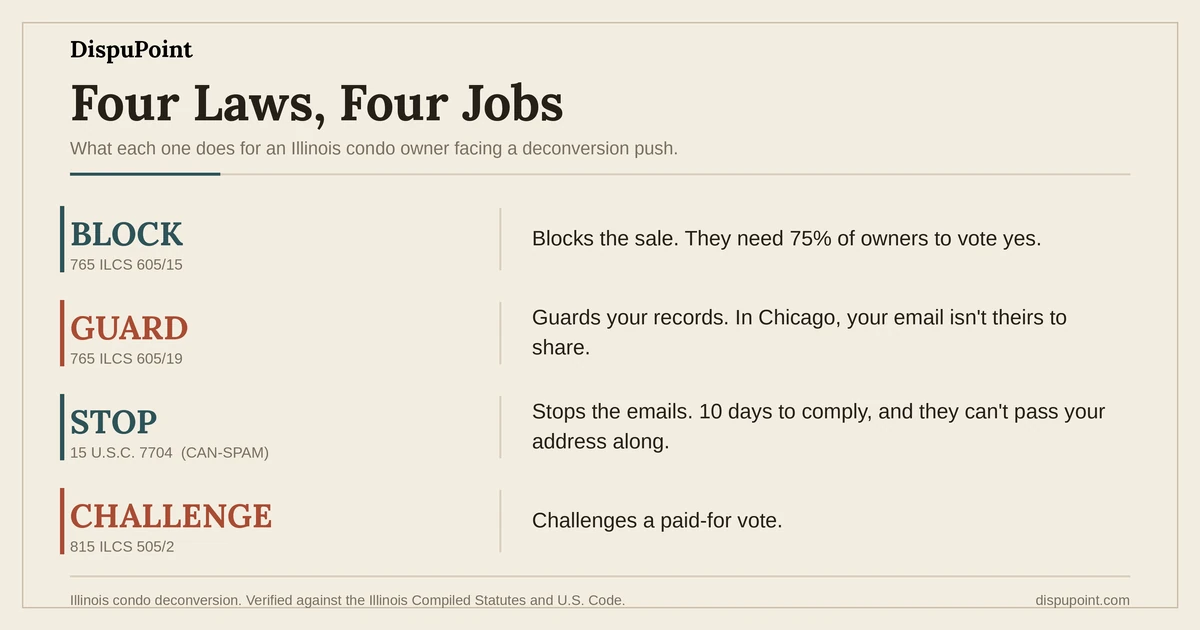
They can't just do it. Under Section 15 of the Illinois Condominium Property Act (765 ILCS 605/15), a bulk sale like this only goes through if at least 75% of unit owners vote yes. Three out of four doors. That bar is high, and it's high on purpose.
So your vote isn't a formality. It's one brick in a wall they need three quarters of to climb over. That's the entire reason they're in your inbox.
Why Are They Emailing You Directly?
Good question. Ask it louder.
These buyers were never supposed to have your personal email. The Illinois Condominium Property Act governs association records at Section 19 (765 ILCS 605/19), and here's the kicker: in the City of Chicago, owner email addresses and phone numbers are specifically left out of the member list an association shares for inspection. On top of that, association records can't be requested for a commercial purpose unrelated to the association. A deconversion buyer hunting for yes votes is about as commercial as it gets.
So how did a private investor end up with your email? If the board or the property manager handed it over, that's not a small slip. That's the association potentially crossing the line Section 19 draws. Ask, in writing, where these buyers got your details and whether anyone actually signed off on releasing them.
What If They Offer You Money for a Yes Vote?
Now it gets uglier.
If one of these emails is dangling a number in front of you, name your price for a yes, that's not pushy salesmanship. That's someone trying to buy a vote the statute was built to keep fair. Conduct like that can run up against the Illinois Consumer Fraud and Deceptive Business Practices Act (815 ILCS 505/2), which targets unfair and deceptive behavior in commercial dealings.
Save those emails like they're made of gold. Don't delete one of them. That's your evidence.
Can They Keep Emailing You After You Said Stop?
Short answer: no. And when they do it anyway, they're not just being rude. They might be breaking the law on two fronts.
Federal first. The CAN-SPAM Act (15 U.S.C. 7704) says commercial senders have to honor an opt-out, and do it quickly. "Please take me off your list" is an opt-out. They do not get to act like they never saw it. That same federal law also bars them from handing your email address off to anyone else once you've opted out.
Illinois has its own anti-spam law too, the Electronic Mail Act (815 ILCS 511/10). Federal CAN-SPAM is the heavier hammer here, but the state law adds pressure, especially when the emails are misleading about who's really behind them or what they're about.
And here's the part that makes this winnable. You don't have to prove they meant any harm. You only have to show that you asked them to stop and they kept going.
So What Do You Do Right Now?
You put it in writing. Not a heated reply, not a phone call that disappears into the air. A written response that creates a record, names the laws standing behind you, and tells the buyer flat out that you're watching. Here's exactly what that looks like.
How to
Send a written opt-out and privacy demand to the deconversion buyer
This single letter pulls double duty. It formally invokes your opt-out rights under CAN-SPAM and the Illinois Electronic Mail Act, and it makes clear you know about the association's records duty too. Send it by email, ask for a read receipt if your mail app offers one, and keep your own copy.
To: [Buyer company name or contact name]
From: [Your name]
Re: Opt-Out Demand and Privacy Notice - [Your building address], Unit [Your unit number]

Dear [Buyer name or "To Whom It May Concern"],

I am a unit owner at [building address]. I have previously requested removal from your email communications on [date(s) of prior requests]. Despite those requests, I continue to receive unsolicited emails from you or your representatives.

Pursuant to the CAN-SPAM Act (15 U.S.C. Section 7704) and the Illinois Electronic Mail Act (815 ILCS 511/10), I am formally demanding that all commercial email communications from your organization to me cease immediately. Any further contact will be documented and may be reported to the Federal Trade Commission and the Illinois Attorney General's office.

I am also formally requesting, in writing, that you identify the source of my contact information. If it was obtained from the condominium association or its property manager, I intend to raise that issue with the board directly.

I have not agreed to sell my unit and I do not consent to further solicitation.

Sincerely,
[Your name]
[Unit number and building address]
[Date]
A dated, statute-citing opt-out builds your paper trail and shows you're nobody's soft target. That alone tends to stop the emails faster than one more "please stop" ever could.
That letter is step one.
You can send the above letter, or we can handle the whole case ourselves, from start to finish.
Get my free assessmentNo payment now. The $349 only starts your case if you act.
Then Take It to Your Board, in Writing
Once you've sent your opt-out letter, turn to your own board. Send a separate, dated email and ask the blunt question: how did these buyers get my contact information, and did anyone here authorize handing it over?
Under Section 19 of the Act (765 ILCS 605/19), your association controls how owner records are shared and for what purpose. If the board can't explain how your email walked out the door, or if they released it for a commercial deconversion push, you have a real basis to push back through the association's dispute process. Different fight from the buyer, same principle. The people in charge don't get to bend the rules just because it's convenient for somebody with money.
And keep an eye on the clock. The vote hasn't happened yet. That means you've still got time to make sure that when it does, it happens clean.
FAQ
Can a condo deconversion buyer legally email unit owners directly?
They can reach out, but they can't ignore an opt-out. Under the CAN-SPAM Act and the Illinois Electronic Mail Act, continuing to send commercial email after you've asked to be removed is a violation. And if the board gave them your contact information, that can raise its own issue under Section 19 of the Condominium Property Act (765 ILCS 605/19), which limits how owner records are shared and used.
What percentage of owners must approve a condo deconversion in Illinois?
Under Section 15 of the Illinois Condominium Property Act (765 ILCS 605/15), at least 75% of unit owners have to vote yes for a bulk sale or deconversion to move forward. One building with enough holdouts can stop the whole deal cold.
Is it legal for a buyer to offer money in exchange for a yes vote?
Soliciting your vote by asking you to name a price can run up against the Illinois Consumer Fraud and Deceptive Business Practices Act (815 ILCS 505/2) as unfair or deceptive conduct in a commercial setting. Document any email like that carefully, and talk to an attorney if you receive one.
What should I do if the board gave my contact information to deconversion buyers?
Send the board a written request asking how the buyers got your information and whether the board authorized the disclosure. Under Section 19 of the Illinois Condominium Property Act (765 ILCS 605/19), the association controls how owner records are shared, and in Chicago, owner emails are excluded from the shareable member list. If the board can't justify it, that's something you can pursue through the association's internal dispute process.
Do I have to sell my unit in a condo deconversion?
If the 75% threshold is met and the vote passes under Section 15, Illinois law does allow the sale to proceed over individual objections. But dissenting owners still have rights, including a fair valuation process. If the vote hasn't passed yet, your no vote counts and you're not required to sell.